
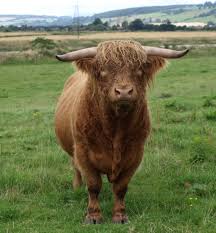
bull基本信息
读法:英 [bʊl]
释义:
使用频率:★★
星级词汇:★★★★
英英释义
Noun:
"a thick-skinned bruiser ready to give as good as he got"
"what he said was mostly bull"
中英词源
bull 公牛,教皇训谕
1.公牛,来自词根bov, 牛,见bovine. 或来自PIE * bhel, 膨胀,见ball.
2.教皇训谕,来自用封蜡(形似小球)密封的教皇下发给下属教会的文件,词源同bill.
- bull
- bull: There are three distinct words bull in English. The oldest is the animal name, which first appears in late Old English as bula. Related forms occur in other Germanic languages, including German bulle and Dutch bul. The diminutive bullock is also recorded in late Old English. The second bull is ‘edict’ [13], as in ‘papal bull’. This comes from medieval Latin bulla ‘sealed document’, a development of an earlier sense ‘seal’, which can be traced back to classical Latin bulla ‘bubble’ (source also of English bowl, as in the game of bowls; of boil ‘heat liquid’; of budge [16], via Old French bouger and Vulgar Latin *bullicāre ‘bubble up, boil’; and probably of bill ‘statement of charges’).
And finally there is ‘ludicrous or selfcontradictory statement’ [17], usually now in the phrase Irish bull, whose origins are mysterious; there may be a connection with the Middle English noun bul ‘falsehood’ and the 15th-to 17th-century verb bull ‘mock, cheat’, which has been linked with Old French boler or bouller ‘deceive’. The source of the modern colloquial senses ‘nonsense’ and ‘excessive discipline’ is not clear.
Both are early 20th-century, and closely associated with the synonymous and contemporary bullshit, suggesting a conscious link with bull the animal. In meaning, however, the first at least is closer to bull ‘ludicrous statement’. Bull’s-eye ‘centre of a target’ and ‘large sweet’ are both early 19th-century. Bulldoze is from 1870s America, and was apparently originally applied to the punishment of recalcitrant black slaves; it has been conjectured that the underlying connotation was of ‘giving someone a dose fit for a bull’.
The term bulldozer was applied to the vehicle in the 1930s.
=> phallic; bill, bowl, budge - bull (n.1)
- "bovine male animal," from Old English bula "a bull, a steer," or Old Norse boli "bull," both from Proto-Germanic *bullon- (cognates: Middle Dutch bulle, Dutch bul, German Bulle), perhaps from a Germanic verbal stem meaning "to roar," which survives in some German dialects and perhaps in the first element of boulder (q.v.). The other possibility [Watkins] is that the Germanic root is from PIE *bhln-, from root *bhel- (2) "to blow, inflate, swell" (see bole).
An uncastrated male, reared for breeding, as opposed to a bullock or steer. Extended after 1610s to males of other large animals (elephant, alligator, whale, etc.). Stock market sense is from 1714 (see bear (n.)). Meaning "policeman" attested by 1859. Figurative phrase to take the bull by the horns first recorded 1711. To be a bull in a china shop, figurative of careless and inappropriate use of force, attested from 1812 and was the title of a popular humorous song in 1820s England. Bull-baiting attested from 1570s. - bull (n.2)
- "papal edict," c. 1300, from Medieval Latin bulla "sealed document" (source of Old French bulle, Italian bulla), originally the word for the seal itself, from Latin bulla "round swelling, knob," said ultimately to be from Gaulish, from PIE *beu-, a root supposed to have formed words associated with swelling (cognates: Lithuanian bule "buttocks," Middle Dutch puyl "bag," also possibly Latin bucca "cheek").
- bull (v.)
- "push through roughly," 1884, from bull (n.1). Related: Bulled; bulling.
- bull (n.3)
- "false talk, fraud," Middle English, apparently from Old French bole "deception, trick, scheming, intrigue," and perhaps connected to modern Icelandic bull "nonsense."
Sais christ to ypocrites ... yee ar ... all ful with wickednes, tresun and bull. ["Cursor Mundi," early 14c.]
There also was a verb bull meaning "to mock, cheat," which dates from 1530s.
词态变化
复数 bulls;
权威造句
- 1. I also met with Pollack again to kind of shoot the bull.
- 我也再次和波拉克会面,两人闲聊了会儿。
来自柯林斯例句
- 2. The origins of bull-riding, which serves no practical purpose, are murkier.
- 骑牛赛没有实际意义,其起源比较令人费解。
来自柯林斯例句
- 3. He was convicted of failing to muzzle a pit bull.
- 他因没能给比特犬戴嘴套而被判有罪。
来自柯林斯例句
- 4. He picked up his first booking for a 45th-minute foul on Bull.
- 他因为在比赛进行到第45分钟时对公牛队犯规而被第一次记名警告。
来自柯林斯例句
- 5. The tan-coloured dog looks suspiciously like an American pit bull terrier.
- 这只棕黄色的狗看上去非常像美国比特犬.
来自柯林斯例句
近反义词
相似短语
单词分析
暂无,等待补充.
记忆方法
1. “红牛”(Red Bull)是全球率先推出且被人熟知的的能量饮品之一。1966年,红牛维生素功能饮料诞生于泰国,迄今为止已有40余年的发展历史。凭着优良的品质和良好的信誉,红牛维生素功能饮料畅销全球140多个国家和地区,稳居全球功能饮料行业的主流地位。
版权声明:问题易所有作品(图文、音视频)均来源网络,版权归原创作者所有,与本站立场无关,如不慎侵犯了你的权益,请联系我们告知,我们将做删除处理!