
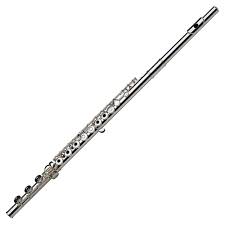
flute基本信息
读法:英 [fluːt] 美 [flut]
释义:
使用频率:★
星级词汇:★★★wwW.wEntIYI.coM
英英释义
Noun:
中英词源
flute 长笛
词源不确定。可能为拟声词或来自辅音丛bl, fl, 吹,鼓起,词源同blow, flatulent. 用来指一种木管乐器。
- flute
- flute: [14] Provençal flaut was probably the original source of flute, and it reached English via Old French floute or floite. Where flaut came from, however, is another matter, and a much disputed one. Some etymologists claim that it is ultimately simply an imitation of a high-pitched sound, its initial consonant cluster perhaps provided by Provençal flajol ‘small flute or whistle’ (source of English flageolet [17], but itself of unknown origin) and Latin flāre ‘blow’; others suggest a specific blend of flajol with Provençal laut, source of English lute.
The sense ‘groove’ developed in English in the 17th century, from a comparison with the long thin shape of the instrument. Related forms in English include flautist [19], whose immediate source, Italian flautisto, preserves the au diphthong of the Provençal source word flaut (American English prefers the older, native English formation flutist [17]); and perhaps flout [16], which may come from Dutch fluiten ‘play the flute’, hence ‘whistle at, mock’.
=> flout - flute (n.)
- early 14c., from Old French flaut, flaute (musical) "flute" (12c.), from Old Provençal flaut, which is of uncertain origin; perhaps imitative or from Latin flare "to blow" (see blow (v.1)); perhaps influenced by Provençal laut "lute." The other Germanic words (such as German flöte) are likewise borrowings from French.
Ancient flutes were direct, blown straight through a mouthpiece but held away from the player"s mouth; the modern transverse or German flute developed 18c. The older style then sometimes were called flûte-a-bec (French, literally "flute with a beak"). The modern design and key system of the concert flute were perfected 1834 by Theobald Boehm. The architectural sense of "furrow in a pillar" (1650s) is from fancied resemblance to the inside of a flute split down the middle. Meaning "tall, slender wine glass" is from 1640s. - flute (v.)
- late 14c., "to play upon the flute," from flute (n.). Meaning "to make (architectural) flutes" is from 1570s. Related: Fluted; fluting.
词态变化
复数 flutes;
权威造句
- 1. Some of the instrumentation is exquisite, particularly for harp and flute.
- 有些器乐段落谱写得非常优美,尤其是竖琴和长笛的部分。
来自柯林斯例句
- 2. a concerto for flute and harp
- 长笛与竖琴协奏曲
来自《权威词典》
- 3. She plays the flute in the school orchestra.
- 她在校管弦乐队里吹长笛。
来自《权威词典》
- 4. There is an extensive repertoire of music written for the flute.
- 有很多供长笛演奏的曲目.
来自《简明英汉词典》
- 5. He took out his flute, and blew at it.
- 他拿出笛子吹了起来.
来自《简明英汉词典》
近反义词
相似短语
单词分析
暂无,等待补充.
记忆方法
1. blow => Latin flare (pp. flatus) "to blow" => flute.
2. perhaps Latin flare (pp. flatus) "to blow" + lute => flute: 用嘴吹奏的乐器.
3. lute => flute.
4. perhaps influenced by lute.
5. f-(谐音“风”) + lute => 用嘴吹风、吹气的乐器。
版权声明:问题易所有作品(图文、音视频)均来源网络,版权归原创作者所有,与本站立场无关,如不慎侵犯了你的权益,请联系我们告知,我们将做删除处理!