
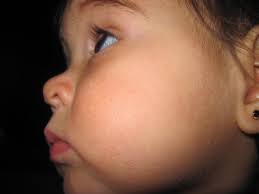
cheek基本信息
读法:英 [tʃiːk] 美 [tʃik]
释义:
使用频率:★★
星级词汇:★★★★
英英释义
Noun:
"he had the effrontery to question my honesty"
中英词源
cheek 脸颊
词源同chew.
- cheek
- cheek: [OE] Old English cēace and cēoce go back respectively to prehistoric West Germanic *kǣkōn and *keukōn, but beyond that the word has no known relatives in other Indo-European languages. It has, however, produced one or two interesting offshoots. It forms the basis of the verb choke, and may be the source of chock-full (literally, ‘full up to the cheeks’); and Middle Dutch kākelen, source of English cackle [13], may be partly based on the related Middle Dutch kāke ‘jaw’. The metaphorical sense ‘impudence’ (whence cheeky) arose in the 19th century, originally as ‘insolent talk’.
=> cackle, chock-full, choke - cheek (n.)
- Old English ceace, cece "jaw, jawbone," in late Old English also "the fleshy wall of the mouth." Perhaps from the root of Old English ceowan "chew" (see chew (v.)), or from Proto-Germanic *kaukon (cognates: Middle Low German kake "jaw, jawbone," Middle Dutch kake "jaw," Dutch kaak), not found outside West Germanic.
Words for "cheek," "jaw," and "chin" tend to run together in IE languages (compare PIE *genw-, source of Greek genus "jaw, cheek," geneion "chin," and English chin); Aristotle considered the chin as the front of the "jaws" and the cheeks as the back of them. The other Old English word for "cheek" was ceafl (see jowl).A thousand men he [Samson] slow eek with his hond,
In reference to the buttocks from c. 1600. Sense of "insolence" is from 1840, perhaps from a notion akin to that which led to jaw "insolent speech," mouth off, etc. To turn the other cheek is an allusion to Matt. v:39 and Luke vi:29.
And had no wepen but an asses cheek.
[Chaucer, "Monk"s Tale"]
词态变化
复数 cheeks;
第三人称单数 cheeks;
过去式 cheeked;
过去分词 cheeked;
现在分词 cheeking;
权威造句
- 1. She knelt and brushed her lips softly across Michael"s cheek.
- 她跪了下来,轻吻迈克尔的脸颊。
来自柯林斯例句
- 2. He kissed her on the cheek. "Best of luck!"
- 他吻了吻她的脸颊。“祝你好运!”
来自柯林斯例句www.WEnTIyi.Com
- 3. How did you get that bruise on your cheek?
- 你脸上的淤伤是怎么搞的?
来自柯林斯例句
- 4. I"m amazed they had the cheek to ask in the first place.
- 我真惊讶他们当初竟然有脸问。
来自柯林斯例句
- 5. Elizabeth walked up to him and pecked him on the cheek.
- 伊丽莎白走到他面前,在他脸颊上匆匆吻了一下。
来自柯林斯例句
近反义词
相似短语
单词分析
暂无,等待补充.
记忆方法
暂无,等待补充.
版权声明:问题易所有作品(图文、音视频)均来源网络,版权归原创作者所有,与本站立场无关,如不慎侵犯了你的权益,请联系我们告知,我们将做删除处理!