
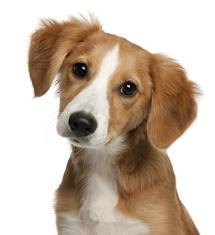
dog基本信息
读法:英 [dɒg] 美 [dɔɡ]
释义:
使用频率:★★★★
星级词汇:★★★★★
英英释义
Noun:
"she"s a real dog"
"the dog chased the rabbit"
中英词源
dog 狗
词源不详,神秘词。
- dog
- dog: [11] Dog is one of the celebrated mystery words of English etymology. It appears once in late Old English, in the Prudentius glosses, where it translates Latin canis, but its use does not seem to have proliferated until the 13th century, and it did not replace the native hound as the main word for the animal until the 16th century. It has no known relatives of equal antiquity in other European languages, although several borrowed it in the 16th and 17th centuries for particular sorts of ‘dog’: German dogge ‘large dog, such as a mastiff’, for instance, French dogue ‘mastiff’, and Swedish dogg ‘bulldog’.
- dog (n.)
- Old English docga, a late, rare word, used in at least one Middle English source in reference to a powerful breed of canine. The word forced out Old English hund (the general Germanic and Indo-European word; see canine) by 16c. and subsequently was picked up in many continental languages (French dogue (16c.), Danish dogge, German Dogge (16c.)), but the origin remains one of the great mysteries of English etymology.
Many expressions -- a dog"s life (c. 1600), go to the dogs (1610s), etc. -- reflect earlier hard use of the animals as hunting accessories, not pampered pets. In ancient times, "the dog" was the worst throw in dice (attested in Greek, Latin, and Sanskrit, where the word for "the lucky player" was literally "the dog-killer"), which plausibly explains the Greek word for "danger," kindynas, which appears to be "play the dog."
Slang meaning "ugly woman" is from 1930s; that of "sexually aggressive man" is from 1950s. Adjectival phrase dog-eat-dog attested by 1850s. Dog tag is from 1918. To dog-ear a book is from 1650s; dog-eared in extended sense of "worn, unkempt" is from 1894.Notwithstanding, as a dog hath a day, so may I perchance have time to declare it in deeds. [Princess Elizabeth, 1550]
Phrase put on the dog "get dressed up" (1934) may look back to the stiff stand-up shirt collars that in the 1890s were the height of male fashion (and were known as dog-collars at least from 1883), with reference to collars worn by dogs. The common Spanish word for "dog," perro, also is a mystery word of unknown origin, perhaps from Iberian. A group of Slavic "dog" words (Old Church Slavonic pisu, Polish pies, Serbo-Croatian pas) likewise are of unknown origin. - dog (v.)
- "to track like a dog," 1510s, see dog (n.). Related: Dogged; dogging.
词态变化
复数 dogs;
第三人称单数 dogs;
过去式 dogged;
过去分词 dogged;
现在分词 dogging;
权威造句
- 1. Politicians want a lap-dog press which will uncritically report their propaganda.
- 政客们想要的是不问是非、甘为他们搞宣传的哈巴狗一样的新闻媒体。
来自柯林斯例句
- 2. With a snarl, the second dog made a dive for his heel.
- 伴着一声嗥叫,第二只狗扑向了他的脚后跟。
来自柯林斯例句
- 3. As soon as he got inside, the dog shook himself.
- 他一进来,狗就开始摇头摆尾。
来自柯林斯例句
- 4. The policeman smiled at her. "Pretty dog."— "Oh well, thank you."
- 警察冲她笑了笑,“这狗真漂亮。”——“哦,谢谢。”
来自柯林斯例句
- 5. You left the latch off the gate and the dog escaped.
- 你没把门闩插上,所以狗跑了。
来自柯林斯例句
近反义词
相似短语
单词分析
暂无,等待补充.
记忆方法
1. 回文构词:dog <---> god, live <---> evil, desserts <---> stressed.
2. 上帝倒立: god => dog.
3. 谐音“大狗”。
版权声明:问题易所有作品(图文、音视频)均来源网络,版权归原创作者所有,与本站立场无关,如不慎侵犯了你的权益,请联系我们告知,我们将做删除处理!