
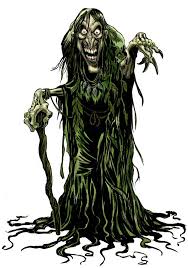
hag基本信息
读法:英 [hæg] 美 [hæɡ]
释义:
使用频率:★
星级词汇:★★
英英释义
Noun:
中英词源
hag 老巫婆,丑老太婆
词源不详,原义为女巫,可能来自古英语haga,树篱,篱笆,围栏,词源同haw,hedge.因传说中女巫骑着树篱飞来飞去而得名,后引申词义丑老太婆。
- hag (n.)
- early 13c., "repulsive old woman" (rare before 16c.), probably from Old English hægtes, hægtesse "witch, sorceress, enchantress, fury," shortened on the assumption that -tes was a suffix. The Old English word is from Proto-Germanic *hagatusjon, which is of unknown origin. Dutch heks, German Hexe "witch" are similarly shortened from cognate Middle Dutch haghetisse, Old High German hagzusa.
The first element probably is cognate with Old English haga "enclosure, portion of woodland marked off for cutting" (see hedge (n.)). Old Norse had tunriða and Old High German zunritha, both literally "hedge-rider," used of witches and ghosts. The second element in the prehistoric compound may be connected with Norwegian tysja "fairy; crippled woman," Gaulish dusius "demon," Lithuanian dvasia "spirit," from PIE *dhewes- "to fly about, smoke, be scattered, vanish."
One of the magic words for which there is no male form, suggesting its original meaning was close to "diviner, soothsayer," which were always female in northern European paganism, and hægtesse seem at one time to have meant "woman of prophetic and oracular powers" (Ælfric uses it to render the Greek "pythoness," the voice of the Delphic oracle), a figure greatly feared and respected. Later, the word was used of village wise women.
Haga is also the haw- in hawthorn, which is an important tree in northern European pagan religion. There may be several layers of folk etymology here. Confusion or blending with heathenish is suggested by Middle English hæhtis, hægtis "hag, witch, fury, etc.," and haetnesse "goddess," used of Minerva and Diana.
If the hægtesse once was a powerful supernatural woman (in Norse it is an alternative word for Norn, any of the three weird sisters, the equivalent of the Fates), it might originally have carried the hawthorn sense. Later, when the pagan magic was reduced to local scatterings, it might have had the sense of "hedge-rider," or "she who straddles the hedge," because the hedge was the boundary between the civilized world of the village and the wild world beyond. The hægtesse would have a foot in each reality. Even later, when it meant the local healer and root collector, living in the open and moving from village to village, it may have had the mildly pejorative Middle English sense of hedge- (hedge-priest, etc.), suggesting an itinerant sleeping under bushes. The same word could have contained all three senses before being reduced to its modern one.
词态变化
复数 hags;
权威造句
- 1. I hope the old hag has gone out to do her grocery shopping and hasn"t come back yet.
- 我希望那个老妖婆出门买杂货还没回来。
来自柯林斯例句wWW.WEnTIyI.Com
- 2. " Come off it, old hag!
- “ 不!不! 不!
来自汉英文学 - 中国现代小说
- 3. An ugly old hag appeared.
- 一位相貌丑陋的老女巫走来.
来自辞典例句
- 4. Syed Mohammed and Hag looked cross.
- 悉德?穆罕默德先生和赫格先生看样子生气了.
来自辞典例句
- 5. This intimation seemed to compose in some degree the vehement passion of the old hag.
- 这番交代似乎使老妖婆的无名怒火稍微平息了一点.
来自辞典例句
近反义词
相似短语
单词分析
暂无,等待补充.
记忆方法
1. 谐音“海鬼、海怪”。
2. 谐音“还格”----“还珠格格”的简称-------因此表示是女性。
版权声明:问题易所有作品(图文、音视频)均来源网络,版权归原创作者所有,与本站立场无关,如不慎侵犯了你的权益,请联系我们告知,我们将做删除处理!