
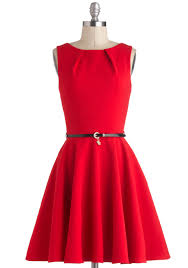
dress基本信息
读法:英 [dres] 美 [drɛs]
释义:
使用频率:★★★★
星级词汇:★★★★★
英英释义
Noun:
"battle dress"
"he always bought his clothes at the same store"
"fastidious about his dress"
"a full-dress uniform"
"dress shoes"
"a full-dress ceremony"
"dress the patient"
"Can the child dress by herself?"
"he dressed up in a suit and tie"
"dress the horses"
中英词源
dress 穿衣,连衣裙
来自法语,词源同direct, 引导,管理。引申义装饰,穿衣,连衣裙等。
- dress
- dress: [14] Dress originally meant literally ‘put right, put straight’. It comes via Old French dresser from Vulgar Latin *dīrectiāre, a derivative of Latin dīrectus ‘straight’ (from which English gets direct). Traces of this underlying sense survive in the word’s application to the correct aligning of columns of troops, but its main modern signification, ‘clothe’, comes via a more generalized line of semantic development ‘prepare’ (as in ‘dress a turkey for the oven’), and hence ‘array, equip’. (English address developed in parallel with dress, and comes from the same ultimate source.) Dresser ‘sideboard’ [15] was borrowed from Old French dresseur, a derivative of dresser in the sense ‘prepare’.
=> address, direct - dress (v.)
- early 14c., "make straight; direct, guide, control, prepare for cooking," from Old French dresser, drecier "raise (oneself), address, prepare, lift, raise, hoist, set up, arrange, set (a table), serve (food), straighten, put right, direct," from Vulgar Latin *directiare, from Latin directus "direct, straight" (see direct (v.)).
Sense of "decorate, adorn" is late 14c., as is that of "put on clothing." Original sense survives in military meaning "align columns of troops." Dress up "attire elaborately" is from 1670s; dressing down "wearing clothes less formal than expected" is from 1960. To dress (someone) down (1769) is ironical. Related: Dressed; dressing. - dress (n.)
- c. 1600, originally any clothing, especially that appropriate to rank or to some ceremony; sense of "woman"s garment" is first recorded 1630s, with overtones of "made not merely to clothe but to adorn." Dress rehearsal first recorded 1828.
词态变化
复数 dresses;
第三人称单数 dresses;
过去式 dressed;
过去分词 dressed;
现在分词 dressing;
权威造句
- 1. Does this dress make my legs look too stumpy?
- 这条裙子会使我的腿看上去又短又粗吗?
来自柯林斯例句
- 2. Maria wore a layered white dress that rustled when she moved.
- 玛丽亚穿一袭白色节裙,一动裙子就窸窣作响。
来自柯林斯例句www.wENTiyi.COM
- 3. Each dress is hemmed and scrupulously checked for imperfections.
- 每条连衣裙都缝上了褶边,并经过严格的检查,不允许有任何瑕疵。
来自柯林斯例句
- 4. "That"s a nice dress," said Michael. "Thanks," she replied solemnly.
- “那件衣服很好看,”迈克尔说。“谢谢,”她严肃地回答。
来自柯林斯例句
- 5. A figure in a blue dress appeared in the doorway.
- 一个穿着蓝色连衣裙的身影出现在门口。
来自柯林斯例句
近反义词
n.
相似短语
单词分析
这些名词均有“衣服、服装”之意。clothes普通用词,多指包括上衣、内衣或裤子等具体的一件件衣服。
clothing常用词,集合名词,是衣服的总称。
coat指上衣、外衣、大衣、外套及女式上装。
dress多指正式场合或为某些特定用途而穿的服装,也指童装或女性穿的连衣裙。
garment语气庄重,正式用词,复数形式可与clothes换用,指身上全部穿着。单数形式指单件衣服,尤指长袍、外套等外面的衣服。
robe指长袍,也指浴衣、晨衣。
gown指女人穿的长服,尤指教士、法官、教授等的礼服或妇女的睡衣等,也指长袍。
uniform指某团体或组织统一做的制服,如军服、校服等。
costume指流行某一地区或某一时代的服装,也指演员的戏装。
suit指一套服装,一般有几件配成一套的套装。 这些动词或词组均含“穿衣,穿”之意。
wear最常用词,指穿衣、鞋袜或戴手套等,侧重穿戴的状态。
dress普通用词,指给自己或他人穿衣。既表动作又可表状态。
put on普通用语,指把衣服、鞋袜、帽子、手套等戴上去,侧重穿戴的动作。
记忆方法
暂无,等待补充.
版权声明:问题易所有作品(图文、音视频)均来源网络,版权归原创作者所有,与本站立场无关,如不慎侵犯了你的权益,请联系我们告知,我们将做删除处理!