
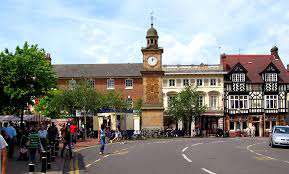
town基本信息
读法:英 [taʊn] 美 [taʊn]
释义:
使用频率:★★★★★
星级词汇:★★★★★WWW.wENtIyi.CoM
英英释义
Noun:
中英词源
town 城镇
来自古英语 tun,村庄,围场,居住区,来自 Proto-Germanic*tuna,栏杆,围栏,来自 PIE*dheue, 围,围住,词源同 down,tune.后用于指城镇,在过去与 city 常混用。
- town
- town: [OE] The ancestral meaning of town is ‘enclosed place’ – amongst its relatives are German zaun ‘hedge, fence’ and Old Irish dūn ‘fort, camp, fortified place’. Its Old English forerunner tūn was used for an ‘enclosure’ or ‘yard’, and also for a ‘building or set of buildings within an enclosure’, hence a ‘farm’. This in due course evolved to a ‘cluster of dwellings’, and by the 12th century the modern English sense of the word was in place (the standard Old English term for ‘town’ was burg, ancestor of modern English borough).
The -ton ending of English place-names goes back in many cases to a time when the word meant ‘farmstead’. - town (n.)
- Old English tun "enclosure, garden, field, yard; farm, manor; homestead, dwelling house, mansion;" later "group of houses, village, farm," from Proto-Germanic *tunaz, *tunan "fortified place" (cognates: Old Saxon, Old Norse, Old Frisian tun "fence, hedge," Middle Dutch tuun "fence," Dutch tuin "garden," Old High German zun, German Zaun "fence, hedge"), an early borrowing from Celtic *dunon "hill, hill-fort" (cognates: Old Irish dun, Welsh din "fortress, fortified place, camp," dinas "city," Gaulish-Latin -dunum in place names), from PIE *dhu-no- "enclosed, fortified place, hill-fort," from root *dheue- "to close, finish, come full circle" (see down (n.2)).
Meaning "inhabited place larger than a village" (mid-12c.) arose after the Norman conquest from the use of this word to correspond to French ville. The modern word is partially a generic term, applicable to cities of great size as well as places intermediate between a city and a village; such use is unusual, the only parallel is perhaps Latin oppidium, which occasionally was applied even to Rome or Athens (each of which was more properly an urbs).
First record of town hall is from late 15c. Town ball, version of baseball, is recorded from 1852. Town car (1907) originally was a motor car with an enclosed passenger compartment and open driver"s seat. On the town "living the high life" is from 1712. Go to town "do (something) energetically" is first recorded 1933. Man about town "one constantly seen at public and private functions" is attested from 1734.
词态变化
复数 towns;
权威造句
- 1. They stumble across a ghost town inhabited by a rascally gold prospector.
- 他们偶然来到一个居住着一位狡诈的淘金者的废墟之城。
来自柯林斯例句
- 2. The new town would have been unrecognisable to the original inhabitants.
- 原来的居民可能会认不出这个崭新的城镇了。
来自柯林斯例句
- 3. As he talked, an airforce jet screamed over the town.
- 他谈话时,一架军用喷气式飞机在镇子上空呼啸而过。
来自柯林斯例句
- 4. Distantly, to her right, she could make out the town of Chiffa.
- 在她右边,远远的,她依稀能辨认出希法镇。
来自柯林斯例句
- 5. I never go on the bus into the town.
- 我从不坐公共汽车去城里。
来自柯林斯例句
近反义词
相似短语
单词分析
这两个名词均含“城市”之意。city一般指大城市或重要城市。
town一般指规模小的城镇,也指城市中的市区,有时也泛指城市。
记忆方法
暂无,等待补充.
版权声明:问题易所有作品(图文、音视频)均来源网络,版权归原创作者所有,与本站立场无关,如不慎侵犯了你的权益,请联系我们告知,我们将做删除处理!