
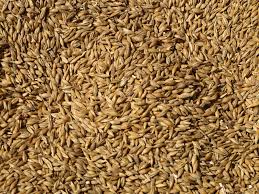
grain基本信息
读法:英 [greɪn] 美 [ɡren]
释义:
使用频率:★★★
星级词汇:★★★★
英英释义
Noun:
"a grain of sugar"
"he does not have a grain of sense"
"sand of a fine grain"
"fish with a delicate flavor and texture"
"a stone of coarse grain"
中英词源
grain 谷物,颗粒
来自PIE*gre-no, 生长,词源同grass, corn. 后指谷物。
- grain
- grain: [13] Grain comes via Old French from Latin grānum ‘seed’. Its prehistoric Indo- European ancestor was *grnóm, literally ‘worndown particle’, which also produced English corn, and it has given English a remarkably wide range of related forms: not just obvious derivatives like granary [16], granule [17], and ingrained [16], but also garner [12] (originally a noun derived from Latin grānārium ‘granary’), gram ‘chick-pea’ [18] (from the Portuguese descendant of grānum, now mainly encountered in ‘gram flour’), grange, granite, gravy, grenade, and the second halves of filigree and pomegranate.
=> filigree, garner, granary, granite, gravy, grenade, ingrained, pomegranate - grain (n.)
- early 14c., "a small, hard seed," especially of one of the cereal plants, also as a collective singular, "seed of wheat and allied grasses used as food;" also "something resembling grain; a hard particle of other substances" (salt, sand, later gunpowder, etc.), from Old French grain, grein (12c.) "seed, grain; particle, drop; berry; grain as a unit of weight," from Latin granum "seed, a grain, small kernel," from PIE root *gre-no- "grain" (see corn (n.1)). From late 14c. as "a species of cereal plant." In the U.S., where corn has a specialized sense, it is the general word (used of wheat, rye, oats, barley, etc.).
Figuratively, "the smallest possible quantity," from late 14c. From early 15c. in English as the smallest unit of weight (originally the weight of a plump, dry grain of wheat or barley from the middle of the ear). From late 14c as "roughness of surface; a roughness as of grains." In reference to wood, "quality due to the character or arrangement of its fibers," 1560s; hence, against the grain (1650), a metaphor from carpentry: cutting across the fibers of the wood is more difficult than cutting along them.
Earliest sense of the word in English was "scarlet dye made from insects" (early 13c.), a sense also in the Old French collateral form graine; see kermes for the evolution of this sense, which was frequent in Middle English; also compare engrain. In Middle English grain also could mean "seed of flowers; pip of an apple, grape, etc.; a berry, legume, nut." Grain alcohol attested by 1854.
词态变化
复数 grains;
权威造句
- 1. The firemen unwrapped their hoses and began dousing the scorched grain silos.
- 消防员展开水龙带,开始冲着烧焦的谷仓喷水。
来自柯林斯例句
- 2. From these ports the grain is freighted down to Addis Ababa.
- 粮食从这些港口运到亚的斯亚贝巴。
来自柯林斯例句
- 3. There"s more than a grain of truth in that.
- 其中含有很深刻的道理。
来自柯林斯例句
- 4. ... grain sells at 10 times usual prices.
- 粮食售价是平常的10倍。
来自柯林斯例句
- 5. Any shortage could push up grain prices.
- 任何一种短缺都会抬高粮食价格。
来自柯林斯例句wWw.WEntIyi.Com
近反义词
相似短语
单词分析
这些名词都有“谷物”之意。corn主要指大麦、小麦、燕麦、裸麦、玉蜀黍这5种谷物及其粒子。
crop指谷物或果类等一年或一季的收成,也可指地里的农业作物或谷物。
grain指稻、麦等谷类及其粒子。 这些名词均有“粒,微粒”之意。
molecule指物质中保持原物质的一切化学性质,能独立存在的最小微粒,即分子。
atom指元素的最小粒子,其体积比molecule小。
particle指任何物质的微粒,引申指任何小的部分。
speck一般指“微点”或“微粒”,可引申指“斑点、污点”。
grain通常指能为肉眼清楚看到的颗粒,比上述几个词所表“粒”的体积大。
记忆方法
1. 天快下雨了,哥哥在下雨之前把谷物扫在一起并用薄膜遮住,以防被雨水淋湿。
版权声明:问题易所有作品(图文、音视频)均来源网络,版权归原创作者所有,与本站立场无关,如不慎侵犯了你的权益,请联系我们告知,我们将做删除处理!