
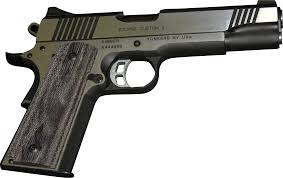
gun基本信息
读法:英 [gʌn] 美 [ɡʌn]
释义:
使用频率:★★★★
星级词汇:★★★★★
英英释义
Noun:
"a twenty gun salute"
中英词源
gun 枪,炮
词源不详,可能来自妇女名Gunilda, 字面意思为战斗,击打。gun, 击打,词源同bane, offend. hilda, 砍,杀,词源同gladiator.
- gun
- gun: [14] Gun probably comes, unlikely as it may seem, from the Scandinavian female forename Gunnhildr (originally a compound of gunnr ‘war’ and hildr ‘war’). It is by no means unusual for large fearsome weapons to be named after women (for reasons perhaps best left to psychologists): the huge German artillery weapon of World War I, Big Bertha, and the old British army musket, Brown Bess, are cases in point.
And it seems that in the Middle Ages Gunnhildr or Gunhild was applied to various large rock-hurling seige weapons, such as the ballista, and later to cannon. The earliest recorded sense of gun (on this theory representing Gunne, a pet form of Gunhild) is ‘cannon’, but it was applied to hand-held firearms as they developed in the 15th century. - gun (n.)
- mid-14c., gunne "an engine of war that throws rocks, arrows or other missiles from a tube by the force of explosive powder or other substance," apparently a shortening of woman"s name Gunilda, found in Middle English gonnilde "cannon" and in an Anglo-Latin reference to a specific gun from a 1330 munitions inventory of Windsor Castle ("... una magna balista de cornu quae Domina Gunilda ..."). Also compare gonnilde gnoste "spark or flame used to fire a cannon" (early 14c.). The woman"s name is from Old Norse Gunnhildr, a compound of gunnr and hildr, both meaning "war, battle." First element from PIE *gwhen- "to strike, kill" (see bane); for second, see Hilda. The identification of women with powerful weapons is common historically (such as Big Bertha, Brown Bess, Mons Meg, etc.). Or perhaps directly from Old Norse gunnr "battle." The word was perhaps influenced by or confirmed by (or possibly from) Old French engon, dialectal variant of engin "engine."
Meaning grew with technology, from cannons to firearms as they developed 15c.; popularly applied to pistols and revolvers from 1744. In modern military use the word is restricted to cannons (which must be mounted), especially long ones used for high velocity and long trajectory. Hence great guns (1884 as an exclamation) distinguished from small guns (such as muskets) from c. 1400. Meaning "thief, rascal" is from 1858. For son of a gun, see son. To jump the gun (1912, American English) is a figurative use from track and field. Guns "a woman"s breasts" (especially if prominent) attested by 2006.[G]un covers firearms from the heaviest naval or siege guns (but in technical use excluding mortars and howitzers) to the soldier"s rifle or the sportsman"s shotgun, and in current U.S. use even the gangster"s revolver. In the other European languages there is no such comprehensive word, but different terms for the small or hand gun of the soldier or sportsman (even these, sometimes differentiated) and the heavy naval guns or artillery pieces .... [Buck, 1949]
- gun (v.)
- "shoot with a gun," 1620s, from gun (n.). Related: Gunned; gunning. The sense of "accelerate an engine" is from 1930, from earlier phrase give (her) the gun (1917), which appears to have originated in pilots" jargon in World War I; perhaps from the old military expression give a gun "order a gun to be fired" (c. 1600).
词态变化
复数 guns;
第三人称单数 guns;
过去式 gunned;
过去分词 gunned;
现在分词 gunning;
Www.wenTIYi.com
权威造句
- 1. Planes dropped bombs and raked the beach with machine gun fire.
- 飞机投下炸弹,并用机关枪扫射海滩。
来自柯林斯例句
- 2. The stationmaster pounced and wrestled the gun from him.
- 站长猛扑过去,奋力夺下他手中的枪。
来自柯林斯例句
- 3. The gun was fired and Beaton was wounded a second time.
- 枪响了,比顿再次受伤。
来自柯林斯例句
- 4. Graham hit him across the face with the gun.
- 格雷厄姆用枪击打他的脸部。
来自柯林斯例句
- 5. He was shot in the head by an air gun pellet.
- 他被气枪弹丸击中头部。
来自柯林斯例句
近反义词
n.
相似短语
单词分析
暂无,等待补充.
记忆方法
暂无,等待补充.
版权声明:问题易所有作品(图文、音视频)均来源网络,版权归原创作者所有,与本站立场无关,如不慎侵犯了你的权益,请联系我们告知,我们将做删除处理!