
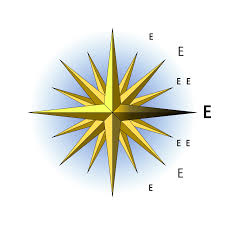
east基本信息
读法:英 [iːst] 美 [ist]
释义:
使用频率:★★★★★WwW.WeNTiyi.coM
星级词汇:★★★★★
英英释义
Noun:
"located east of Rome"
中英词源
east 东方的
来自PIE*aus, 光照,照耀,词源同aurora, aureate.
- east
- east: [OE] Etymologically, east is the point of the compass at which the sun rises (and hence is a parallel formation to orient, which comes from a Latin word originally meaning ‘rising’). It goes back to an Indo-European base *aus-, source of a range of terms meaning not only ‘east’ but also ‘dawn’; Latin aurora, for instance, and Greek aúōs, had both senses.
Its Germanic descendant, *austo-, produced German ost, Dutch oosten, Swedish öster, and English east (which was subsequently borrowed by French as est). It was also the source of *Austron, the name of a goddess of the prehistoric Germanic peoples, originally the dawn-goddess, whose festival occurred in spring. In Old English her name was Ēastre, which is generally taken to be the ultimate source of English Easter (German Ostern ‘Easter’ has a parallel origin).
=> easter - east
- Old English east, eastan (adj., adv.) "east, easterly, eastward;" easte (n.), from Proto-Germanic *aust- "east," literally "toward the sunrise" (cognates: Old Frisian ast "east," aster "eastward," Dutch oost Old Saxon ost, Old High German ostan, German Ost, Old Norse austr "from the east"), from PIE *aus- (1) "to shine," especially of the dawn (cognates: Sanskrit ushas "dawn;" Greek aurion "morning;" Old Irish usah, Lithuanian auszra "dawn;" Latin aurora "dawn," auster "south;" see aurora). The east is the direction in which dawn breaks. For theory of shift in the geographical sense in Latin, see Australia.
As one of the four cardinal points of the compass, from c. 1200. Meaning "the eastern part of the world" (from Europe) is from c. 1300. Cold War use of East for "communist states" first recorded 1951. French est, Spanish este are borrowings from Middle English, originally nautical. The east wind in Biblical Palestine was scorching and destructive (as in Ezek. xvii:10); in New England it is bleak, wet, unhealthful. East End of London so called by 1846; East Side of Manhattan so called from 1871; East Indies (India and Southeast Asia) so called 1590s to distinguish them from the West Indies.
词态变化
权威造句
- 1. Big credits were given to East Germany by successive West German governments.
- 历届西德政府给予东德大量的贷款。
来自柯林斯例句
- 2. Middle East peace talks in Washington showed signs of progress yesterday.
- 昨天在华盛顿举行的中东和谈有了取得进展的迹象。
来自柯林斯例句
- 3. The river widens considerably as it begins to turn east.
- 河流转向东流时河道大幅度变宽。
来自柯林斯例句
- 4. We drove east to Rostock, where my map led me astray.
- 我们驱车向东去罗斯托克,但地图却给我指错了方向。
来自柯林斯例句
- 5. The agent spied for East Germany for more than twenty years.
- 该特工人员为东德做了20多年的间谍。
来自柯林斯例句
近反义词
相似短语
单词分析
暂无,等待补充.
记忆方法
暂无,等待补充.
版权声明:问题易所有作品(图文、音视频)均来源网络,版权归原创作者所有,与本站立场无关,如不慎侵犯了你的权益,请联系我们告知,我们将做删除处理!