
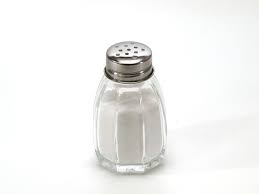
salt基本信息
读法:英 [sɔːlt; sɒlt] 美 [sɔlt]
释义:
使用频率:★★★
星级词汇:★★★★★
英英释义
Noun:
"a salt apology"
中英词源
salt 盐,食盐
来自古英语 sealt,盐,来自 Proto-Germanic*saltom,盐,来自 PIE*sal,盐,词源同 halogen,saline.
- salt
- salt: [OE] Salt was a key element in the diet of our Indo-European ancestors, and their word for it, *sal-, is the source of virtually all the modern European terms, including Russian sol’, Polish sól, Serbo-Croat so, Irish salann, and Welsh halen. Greek háls has given English halogen [19]. And Latin sāl, besides evolving into French sel, Italian sale, Spanish sal, and Romanian sare, has contributed an enormous range of vocabulary to English, including salad, salary, saline [15], salsa, sauce, saucer, and sausage.
Its Germanic descendant was *salt-, which has produced Swedish, Danish, and English salt and Dutch zout, and also lies behind English silt and souse.
=> halogen, salad, salary, saline, salsa, sauce, saucer, sausage, silt, souse - SALT (n.)
- Cold War U.S.-U.S.S.R. nuclear weapons negotiations, 1968, acronym for Strategic Arms Limitation Talks (which would make SALT talks redundant, but the last element sometimes also is understood as treaty).
- salt (n.)
- Old English sealt "salt" (n.; also as an adjective, "salty, briny"), from Proto-Germanic *saltom (cognates: Old Saxon, Old Norse, Old Frisian, Gothic salt, Dutch zout, German Salz), from PIE *sal- (1) "salt" (cognates: Greek hals "salt, sea," Latin sal, Old Church Slavonic soli, Old Irish salann, Welsh halen "salt").
Modern chemistry sense is from 1790. Meaning "experienced sailor" is first attested 1840, in reference to the salinity of the sea. Salt was long regarded as having power to repel spiritual and magical evil. Many metaphoric uses reflect that this was once a rare and important resource, such as worth one"s salt (1830), salt of the earth (Old English, after Matt. v:13). Belief that spilling salt brings bad luck is attested from 16c. To be above (or below) the salt (1590s) refers to customs of seating at a long table according to rank or honor, and placing a large salt-cellar in the middle of the dining table.
Salt-lick first recorded 1751; salt-marsh is Old English sealtne mersc; salt-shaker is from 1882. Salt-and-pepper "of dark and light color" first recorded 1915. To take something with a grain of salt is from 1640s, from Modern Latin cum grano salis. - salt (v.)
- Old English sealtan, from Proto-Germanic *salto- (see salt (n.)), and in part from the noun. Related: Salted; salting.
词态变化
第三人称单数 salts;
过去式 salted;
过去分词 salted;
现在分词 salting;
权威造句
- 1. Season with salt, pepper and a pinch of cayenne.
- 调以盐、胡椒和少许辣椒粉。
来自柯林斯例句
- 2. Any coach worth his salt would do exactly as I did.
- 任何称职的教练都会采取和我一模一样的行动。
来自柯林斯例句
- 3. Salt the stock to your taste and leave it simmering very gently.
- 根据自己的口味给原汤加点盐,然后用文火慢炖。
来自柯林斯例句
- 4. Too much salt masks the true flavour of the food.
- 太多的盐会盖住食物本来的味道。
来自柯林斯例句wWw.wENTiyi.COm
- 5. Prick the potatoes and rub the skins with salt.
- 将马铃薯戳一些洞,并用盐揉搓外皮。
来自柯林斯例句
近反义词
相似短语
单词分析
暂无,等待补充.
记忆方法
暂无,等待补充.
版权声明:问题易所有作品(图文、音视频)均来源网络,版权归原创作者所有,与本站立场无关,如不慎侵犯了你的权益,请联系我们告知,我们将做删除处理!