
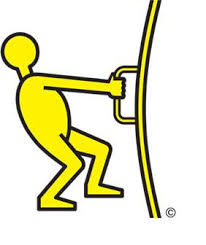
pull基本信息
读法:英 [pʊl] 美 [pʊl]
释义:
使用频率:★★★★
星级词汇:★★★★★
英英释义
Noun:
"his strenuous pulling strained his back"
"the pull of the current"
"he was sidelined with a hamstring pull"
"he took a drag on his cigarette and expelled the smoke slowly"
"pull a sled"
"The ad pulled in many potential customers"
"This pianist pulls huge crowds"
"The store owner was happy that the ad drew in many new customers"
"Pull the handle towards you"
"pull the string gently"
"pull the trigger of the gun"
"pull your knees towards your chin"
"pull a bank robbery"
"pull out a gun"
"The mugger pulled a knife on his victim"
"Pull the car over"
"The athlete pulled a tendon in the competition"
"pull the cooked chicken into strips"
"pluck the capon"
"extract a bad tooth"
"take out a splinter"
"extract information from the telegram"
"I"m pulling for the underdog"
"Are you siding with the defender of the title?"
中英词源
pull 拉,拖,吸引
来自古英语pullian,拉,拔羊毛,词源不详。可能来自PIE*pil,拔,羊毛,毛发,词源同pluck,fleece.
- pull
- pull: [OE] The main Old and Middle English word for ‘pull’ was draw, and pull did not really begin to come into its own until the late 16th century. It is not known for certain where it came from. Its original meaning was ‘pluck’ (‘draw, drag’ is a secondary development), and so it may well be related to Low German pūlen ‘remove the shell or husk from, pluck’ and Dutch peul ‘shell, husk’.
- pull (v.)
- c. 1300, "to move forcibly by pulling, to drag," from Old English pullian "to pluck off (wool), to draw out," of unknown origin, perhaps related to Low German pulen "remove the shell or husk," Frisian pûlje "to shell, husk," Middle Dutch polen "to peel, strip," Icelandic pula "work hard."
Early 14c. as "to pick, pull off, gather" (fruit, flowers, berries, leaves, petals, etc.); mid-14c. as "to uproot, pull up" (of teeth, weeds, etc.). Sense of "to draw, attract" (to oneself) is from c. 1400; sense of "to pluck at with the fingers" is from c. 1400. Meaning "tear to pieces" is mid-15c. By late 16c. it had replaced draw in these senses. Related: Pulled; pulling.
Common in slang usages 19c.-20c.; Bartlett (1859) has to pull foot "walk fast; run;" pull it "to run." To pull up "check a course of action" is from 1808, figurative of the lifting of the reins in horse-riding. To pull (someone"s) chain in figurative sense is from 1974, perhaps on the notion of a captive animal; the expression was also used for "to contact" (someone), on the notion of the chain that operates a signaling mechanism.
To pull (someone"s) leg is from 1882, perhaps on notion of "playfully tripping" (compare pull the long bow "exaggerate," 1830, and pulling someone"s leg also sometimes was described as a way to awaken a sleeping person in a railway compartment, ship"s berth, etc.). Thornton"s "American Glossary" (1912) has pull (n.) "a jest" (to have a pull at (someone)), which it identifies as "local" and illustrates with an example from the Massachusetts "Spy" of May 21, 1817, which identifies it as "a Georgian phrase." To pull (one"s) punches is from 1920 in pugilism, from 1921 figuratively. To pull in "arrive" (1892) and pull out "depart" (1868) are from the railroads.
To pull (something) off "accomplish, succeed at" is originally in sporting, "to win the prize money" (1870). To pull (something) on (someone) is from 1916; to pull (something) out of one"s ass is Army slang from 1970s. To pull rank is from 1919; to pull the rug from under (someone) figuratively is from 1946. - pull (n.)
- c. 1300, "a fishing net;" mid-14c., "a turn at pulling," from pull (v.). From mid-15c. as "an act of pulling." Meaning "personal or private influence" is by 1889, American English, from earlier sense "power to pull (and not be pulled by)" a rival or competitor (1580s).
词态变化
第三人称单数 pulls;
过去式 pulled;
过去分词 pulled;
现在分词 pulling;
权威造句
- 1. The pull-out of the army paves the way for independence.
- 军队的撤出为独立铺平了道路。
来自柯林斯例句
- 2. I only pull in 15,000 a year as a social worker.
- 作为一名社工,我每年仅挣15,000。
来自柯林斯例句
- 3. Suddenly all the men pull out pistols and begin blasting away.
- 突然,所有人都拔出手枪,连续射击。
来自柯林斯例句
- 4. The banks have the power to pull the plug on the project.
- 银行有能力让该工程终止。
来自柯林斯例句
- 5. The organisers have to employ performers to pull a crowd.
- 组织者不得不雇些演员来聚拢人气。
来自柯林斯例句
近反义词
v.
相似短语
单词分析
这些动词都有“拖、拉”之意。drag指沿斜坡而上或水平方向缓慢地拖或拉十分沉重的人或物。作借喻时可指把人硬拉扯过来。
draw指将人或物朝出力者的方向拖,不涉及力的大小,含平稳意味,常作借喻用。
pull最普通用词,包含本组其它各词的一些意思,可指朝各个方向拉,侧重一时或突然拉动的动作。
haul指用力拖或拉,不涉及方向,多作航海用词。
tug多指一阵阵地用力拖或拉,但不一定使被拉的人或物移动。
tow特指用绳子或链条等拖或拉本身无动力或无法使用自身动力的东西。
jerk指快而突然地拉。
记忆方法
暂无,等待补充.
版权声明:问题易所有作品(图文、音视频)均来源网络,版权归原创作者所有,与本站立场无关,如不慎侵犯了你的权益,请联系我们告知,我们将做删除处理!