
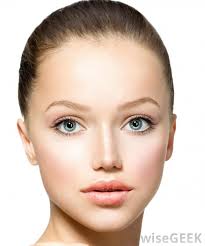
face基本信息
读法:英 [feɪs] 美 [fes]
释义:
使用频率:★★★★★
星级词汇:★★★★★
英英释义
Noun:
"I wish I had seen the look on his face when he got the news"
"a look of triumph"
"an angry face"
"when he returned to work he met many new faces"
"dew dripped from the face of the leaf"
"he had the effrontery to question my honesty"
"He faced the terrible consequences of his mistakes"
"Jackson faced Smith in the boxing ring"
"The two enemies finally confronted each other"
"My backyard look onto the pond"
"The building faces the park"
"the two sofas face each other"
"He was faced with all the evidence and could no longer deny his actions"
"An enormous dilemma faces us"
中英词源
face 脸
来自PIE*dhe, 做,放置,语源同do, fact. 即做出来的形状,脸面,并取代拉丁语visage.
- face
- face: [13] The notion that a person’s face ‘is’ their appearance, what they look like to the rest of the world, lies behind the word face. It probably comes from a prehistoric base *fac-, signifying ‘appear’. This gave rise to Latin faciēs, which originally meant ‘appearance, aspect, form’, and only secondarily, by figurative extension, ‘face’. In due course it passed via Vulgar Latin *facia into Old French as face, from which English acquired it (French, incidentally, dropped the sense ‘face’ in the 17th century, although the word face is retained for ‘front, aspect’, etc).
Related forms in English include facade [17], facet [17] (originally a diminutive), superficial and surface.
=> facade, facet, superficial, surface - face (n.)
- c. 1300, "the human face, a face; facial appearance or expression; likeness, image," from Old French face "face, countenance, look, appearance" (12c.), from Vulgar Latin *facia (source also of Italian faccia), from Latin facies "appearance, form, figure," and secondarily "visage, countenance," which probably is literally "form imposed on something" and related to facere "to make" (see factitious).
Replaced Old English andwlita "face, countenance" (from root of wlitan "to see, look") and ansyn, ansien, the usual word (from the root of seon "see"). Words for "face" in Indo-European commonly are based on the notion of "appearance, look," and are mostly derivatives from verbs for "to see, look" (as with the Old English words, Greek prosopon, literally "toward-look," Lithuanian veidas, from root *weid- "to see," etc.). But in some cases, as here, the word for "face" means "form, shape." In French, the use of face for "front of the head" was given up 17c. and replaced by visage (older vis), from Latin visus "sight."
From late 14c. as "outward appearance (as contrasted to some other reality);" also from late 14c. as "forward part or front of anything;" also "surface (of the earth or sea), extent (of a city)." Typographical sense of "part of the type which forms the letter" is from 1680s.Whan she cometh hoom, she raumpeth in my face And crieth "false coward." [Chaucer, "Monk"s Tale"]
Face to face is from mid-14c. Face time is attested from 1990. To lose face (1876), is said to be from Chinese tu lien; hence also save face (1915). To show (one"s) face "make or put in an appearance" is from mid-14c. (shewen the face). To make a face "change the appearance of the face in disgust, mockery, etc." is from 1560s. Two faces under one hood as a figure of duplicity is attested from mid-15c.Two fases in a hode is neuer to tryst. ["Awake lordes," 1460]
- face (v.)
- "confront with assurance; show a bold face," mid-15c., from face (n.). From c. 1400 as "deface, disfigure." Meaning "to cover with something in front" is from 1560s; that of "turn the face toward" is from 1630s; meaning "be on the opposite page to" is from 1766. Intransitive sense "to turn the face" (especially in military tactics) is from 1630s. Related: Faced; facing. To face the music (1850, in U.S. Congressional debates) probably is theatrical rather than a reference to cavalry horses.
词态变化
复数 faces;
第三人称单数 faces;
过去式 faced;
过去分词 faced;
现在分词 facing;
www.WENtIyi.COM
权威造句
- 1. They have maintained their optimism in the face of desolating subjugation.
- 面对遭征服的悲惨命运,他们保持了乐观的态度。
来自柯林斯例句
- 2. The cold, misty air felt wonderful on his face.
- 雾蒙蒙,寒冷的空气使他脸上感觉很舒爽。
来自柯林斯例句
- 3. He will now face a disciplinary hearing for having an affair.
- 他因有外遇而要面临纪律听证会的裁决。
来自柯林斯例句
- 4. A young man plunged from a sheer rock face to his death.
- 一名男青年从陡峭的岩壁上坠崖身亡。
来自柯林斯例句
- 5. The government wilted in the face of such powerful pressure.
- 政府面对如此大的压力,失去了信心。
来自柯林斯例句
近反义词
n.
相似短语
单词分析
这些名词均含事物或人的“外表,容貌”之意。appearance普通用词,着重由总体产生的印象。
look普通用词,多用复数,可与appearance换用,但较口语化。
face侧重指容貌。
aspect书面用词,突出人或事物在某特定时间或地点时的外貌。 这些动词均有“遇见,会见,碰见”之意。
meet普通用词,本义指双方或多方从不同方向或相反方向作向对运动,最终相碰(遇)。
encounter通常指遇到困难或挫折,也指偶然或意外地相遇。
confront 不可避免的,面对面的相遇。也指敢于正视困难或问题的决心和信心。
face侧重双方静止地面对面,或指指充满勇气、信心和决心正视人或事。
contact多指通过书信、电话或直接会面和别人联系。口语用词。
记忆方法
暂无,等待补充.
版权声明:问题易所有作品(图文、音视频)均来源网络,版权归原创作者所有,与本站立场无关,如不慎侵犯了你的权益,请联系我们告知,我们将做删除处理!