
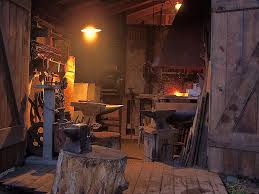
forge基本信息
读法:英 [fɔːdʒ] 美 [fɔrdʒ]
释义:
使用频率:★★
星级词汇:★★★★
英英释义
Noun:
"forge a pair of tongues"
"they counterfeited dollar bills"
"She forged a Green Card"
"Form cylinders from the dough"
"shape a figure"
"Work the metal into a sword"
中英词源
forge 锻造,伪造
来自古法语forge,铸造,锻造,来自拉丁语fabrica, 铁匠铺,车间,词源同fabric.引申贬义词义伪造。
- forge
- forge: Forge ‘make’ [13] and forge ahead [17] are two quite distinct and unrelated words in English. The former’s now common connotation of ‘faking’ is in fact a purely English development (dating from the late 14th century) in a word whose relatives in other languages (such as French forger) mean simply ‘make – especially by working heated metal’. It comes via Old French forger from Latin fabricāre ‘make’ (source also of English fabricate, which has similarly dubious connotations).
The related noun forge goes back to Latin fabrica (whence also English fabric), amongst whose specialized senses was ‘blacksmith’s workshop’. Forge ‘move powerfully’, as in forge ahead, may be an alteration of force.
=> fabric - forge (n.)
- late 14c., "a smithy," from Old French forge "forge, smithy" (12c.), earlier faverge, from Latin fabrica "workshop, smith"s shop," hence also "a trade, an industry;" also "a skillful production, a crafty device," from faber (genitive fabri) "workman in hard materials, smith" (see fabric). As the heating apparatus itself (a furnace fitted with a bellows), from late 15c. Forge-water (1725), in which heated iron has been dipped, was used popularly as a medicine in 18c.
- forge (v.2)
- 1769 (with an apparent isolated use from 1610s), "make way, move ahead," of unknown origin, perhaps an alteration of force (v.), but perhaps rather from forge (n.), via notion of steady hammering at something. Originally nautical, in reference to vessels.
- forge (v.1)
- early 14c., "to counterfeit" (a letter, document, etc.), from Old French forgier "to forge, work (metal); shape, fashion; build, construct; falsify" (12c., Modern French forger), from Latin fabricari "to frame, construct, build," from fabrica "workshop" (see forge (n.)). Meaning "to counterfeit" (a letter, document, or other writing) is from early 14c.; literal meaning "to form (something) by heating in a forge and hammering" is from late 14c. in English, also used in Middle English of the minting of coins, so that it once meant "issue good money" but came to mean "issue spurious (paper) money." Related: Forged; forging.
词态变化
复数 forges;
第三人称单数 forges;
过去式 forged;
过去分词 forged;
现在分词 forging;
权威造句
- 1. He again pledged to forge ahead with his plans for reform.
- 他再次承诺会稳步推进自己的改革计划。
来自柯林斯例句
- 2. The programme aims to forge links between higher education and small businesses.
- 这个项目旨在为高等教育和小企业之间建立联系。
来自柯林斯例句
- 3. The project will help inmates forge new careers.
- 这项计划会帮助犯人开始新的职业。
来自柯林斯例句
- 4. To forge a blade takes great skill.
- 锻造刀刃需要很高超的技巧。
来自柯林斯例句
- 5. a move to forge new links between management and workers
- 努力建立劳资新关系的措施
来自《权威词典》
近反义词
相似短语
单词分析
这些动词均有“使成形”之意。mould通常指把有延展性的材料浇铸或塑成所需形状的物品。
forge意义较窄,指用锤子和砧对金属材料进行加工或锻造。
form通常指对尚未成形的物品作进一步加工,使成为成品。
shape比mould使用广泛,指用许多不同的方法制成不同形状的制品。
记忆方法
“仿制”---伪造,锻造
2. fabric => forge.
版权声明:问题易所有作品(图文、音视频)均来源网络,版权归原创作者所有,与本站立场无关,如不慎侵犯了你的权益,请联系我们告知,我们将做删除处理!