
ether基本信息
读法:英 ["iːθə] 美 ["iθɚ]
释义:
使用频率:★
星级词汇:★★
英英释义
Noun:
中英词源
ether 乙醚
来自PIE*aidh, 燃烧,词源同edifice, ardor. 原来指纯火燃烧之地,最高天,苍穹。后用来指乙醚,因其轻而得名。参照empyrean.WWw.WenTiyi.coM
- ether
- ether: [17] Greek aithér denoted the ‘upper atmosphere’, and by extension the ‘substance that permeated the cosmos’, from which the stars and planets were made. It was a derivative of the verb aíthein ‘ignite, blaze, shine’, a relative of Latin aestās ‘summer’, from which English gets aestivate [17]. It passed into English via Latin aethēr, and to begin with was used in its original Greek senses. Its application to the liquid with anaesthetic properties dates from the mid 18th century, the use of its first syllable in the names of organic compounds in the bicarbon series (such as ethyl and ethane) from the mid 19th century.
=> aestivate, ethyl - ether (n.)
- late 14c., "upper regions of space," from Old French ether (12c.) and directly from Latin aether "the upper pure, bright air; sky, firmament," from Greek aither "upper air; bright, purer air; the sky" (opposed to aer "the lower air"), from aithein "to burn, shine," from PIE *aidh- "to burn" (see edifice).
In ancient cosmology, the element that filled all space beyond the sphere of the moon, constituting the substance of the stars and planets. Conceived of as a purer form of fire or air, or as a fifth element. From 17c.-19c., it was the scientific word for an assumed "frame of reference" for forces in the universe, perhaps without material properties. The concept was shaken by the Michelson-Morley experiment (1887) and discarded early 20c. after the Theory of Relativity won acceptance, but before it went it gave rise to the colloquial use of ether for "the radio" (1899).
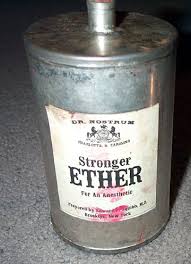
The name also was bestowed c. 1730 (Frobenius; in English by 1757) on a volatile chemical compound known since 14c. for its lightness and lack of color (its anesthetic properties weren"t fully established until 1842).
词态变化
权威造句
- 1. Her words disappeared into the ether.
- 她的话消失在九霄云外。
来自《权威词典》
- 2. He lost consciousness at the first whiff of ether.
- 他一嗅到乙醚便失去了知觉.
来自《简明英汉词典》
- 3. They imagined the existence of a physical medium - the ether - filling all of space.
- 他们想象存在一种充满整个空间的物理介质 -- 以太.
来自辞典例句
- 4. Today"s news goes into the ether and is soon forgotten.
- 今天的新闻广播听后不久即置于脑后了.
来自辞典例句
- 5. General relativity has reintroduced a new and subtle " ether"space - time itself.
- 广义相对论再度引进一个新的,难以想象的 “ 以太 ” --空时本身.
来自辞典例句
近反义词
相似短语
单词分析
暂无,等待补充.
记忆方法
暂无,等待补充.
版权声明:问题易所有作品(图文、音视频)均来源网络,版权归原创作者所有,与本站立场无关,如不慎侵犯了你的权益,请联系我们告知,我们将做删除处理!