
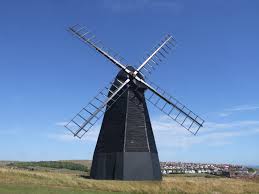
mill基本信息
读法:英 [mɪl]
释义:
使用频率:★★★
星级词汇:★★★★
英英释义
Noun:
中英词源
mill 磨坊,工厂
来自希腊语molere,磨,来自PIE*mel,软,锤打,磨,词源同mallet,melt.引申词义磨坊,磨石,因磨坊在农业社会是比较有代表性的工业产品,后借用该词来指现代意义上的工厂。www.WeNTIYI.cOM
- mill
- mill: [OE] Mill is one of a large family of English words that go back ultimately to the Indo- European base *mel-, *mol-, *ml-, denoting ‘grind’. It includes meal ‘flour’, mollify, mollusc, mould ‘earth’, and (via the extended form *meld-, *mold-) melt and mild. One particular subset of the family comes from closely related Latin sources: the verb molere ‘grind’ has produced emolument and ormolu [18] (etymologically ‘ground gold’); the noun mola ‘grindstone’ has given molar [16] and (via a later sense ‘flour mixed with salt, sprinkled on sacrificial victims’) immolate [16]; and late Latin molīnus ‘grindstone’, which replaced classical Latin mola, was borrowed into Old English as mylen, from which we get modern English mill.
=> emolument, meal, melt, mild, molar, mollify, mollusc, mould, ormolu - mill (n.1)
- "building fitted to grind grain," Old English mylen "a mill" (10c.), an early Germanic borrowing from Late Latin molina, molinum "mill" (source of French moulin, Spanish molino), originally fem. and neuter of molinus "pertaining to a mill," from Latin mola "mill, millstone," related to molere "to grind," from PIE *mel- (1) "soft," with derivatives referring to ground material and tools for grinding (source also of Greek myle "mill;" see mallet).
Also from Late Latin molina, directly or indirectly, are German Mühle, Old Saxon mulin, Old Norse mylna, Danish mølle, Old Church Slavonic mulinu. Broader sense of "grinding machine" is attested from 1550s. Other types of manufacturing machines driven by wind or water, whether for grinding or not, began to be called mills by early 15c. Sense of "building fitted with industrial machinery" is from c. 1500. - mill (n.2)
- "one-tenth cent," 1786, an original U.S. currency unit but now used only for tax calculation purposes, shortening of Latin millesimum "one-thousandth," from mille "a thousand" (see million). Formed on the analogy of cent, which is short for Latin centesimus "one hundredth" (of a dollar).
- mill (v.2)
- "to keep moving round and round in a mass," 1874 (implied in milling), originally of cattle, from mill (n.1) on resemblance to the action of a mill wheel. Related: Milled.
- mill (v.1)
- "to grind," 1550s, from mill (n.1). Related: milled; milling.
词态变化
复数 mills;
第三人称单数 mills;
过去式 milled;
过去分词 milled;
现在分词 milling;
权威造句
- 1. I was just a very average run-of-the-mill kind of student.
- 我只是一个普普通通的学生。
来自柯林斯例句
- 2. They mill 1,000 tonnes of flour a day in every Australian state.
- 澳大利亚各州每天都要磨1,000吨面粉。
来自柯林斯例句
- 3. For many they clearly represent an alternative to run-of-the-mill estate cars.
- 对于很多人来说,他们显然可以作为一般旅行车的替代品。
来自柯林斯例句
- 4. Every night you could hear the whistles of the steel mill.
- 每晚你都会听见炼钢厂的下班哨声。
来自柯林斯例句
- 5. He met mill hands, miners and farm labourers.
- 他见过工厂工人、矿工和农场工人。
来自柯林斯例句
近反义词
相似短语
单词分析
暂无,等待补充.
记忆方法
暂无,等待补充.
版权声明:问题易所有作品(图文、音视频)均来源网络,版权归原创作者所有,与本站立场无关,如不慎侵犯了你的权益,请联系我们告知,我们将做删除处理!