
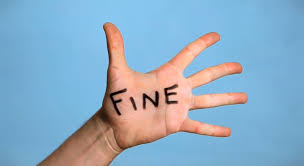
fine基本信息
读法:英 [faɪn] 美 [faɪn]
释义:
使用频率:★★★
星级词汇:★★★★★
英英释义
Noun:
"the passengers were shaken up but are all right"
"is everything all right?"
"everything"s fine"
"things are okay"
"dinner and the movies had been fine"
"another minute I"d have been fine"
"fine hairs"
"read the fine print"
"looking fine in her Easter suit"
"a fine gentleman"
"fine china and crystal"
"a fine violinist"
"the fine hand of a master"
"fine powdery snow"
"fine rain"
"batiste is a cotton fabric with a fine weave"
"covered with a fine film of dust"
"her fine drawn body"
"Move your car or else you will be ticketed!"
中英词源
fine 好的,精细的,罚金
来自拉丁语finis, 终结,边界,词源同finish. 引申义接近极点的,最高程度的,精细的,好的。罚金义来自终结债务,解决争端等。词义演变参照sublime.
- fine
- fine: [12] Both the adjective and the noun fine have come a very long way since their beginnings in Latin finis ‘end’. The etymological sense of the adjective is ‘finished’ – hence, ‘of high quality’. It comes via Old French fin from Vulgar Latin *fīnus, an adjective formed from the Latin verb fīnīre ‘limit, complete’ (source of English finish). (A derivative of *finus was the noun *finitia, from which ultimately English gets finesse [15].) The noun fine also comes from an Old French fin, this time a noun descended directly from Latin fīnis.
In medieval times this was used for ‘money to be paid at the completion of legal proceedings’ – hence the present-day sense ‘payment imposed as a punishment’. From the same ultimate source, but reflecting different aspects of it, come confine [16] and define [14] (‘limitation’) and refine [16] (‘high quality’).
=> confine, define, final, finance, finesse, finish, refine - fine (adj.)
- mid-13c., "unblemished, refined, pure, free of impurities," also "of high quality, choice," from Old French fin "perfected, of highest quality" (12c.), a back-formation from finire or else from Latin finis "that which divides, a boundary, limit, border, end" (see finish (v.)); hence "acme, peak, height," as in finis boni "the highest good." The English word is from c. 1300 as "rich, valuable, costly;" also in a moral sense "true, genuine; faithful, constant." From late 14c. as "expertly fashioned, well or skillfully made," also, of cloth, "delicately wrought." Of weapons or edges, "sharp" from c. 1400. In reference to quality of gold and silver, late 15c.
In French, the main meaning remains "delicate, intricately skillful;" in English since c. 1300 fine has been also a general broad expression of admiration or approval, the equivalent of French beau (as in fine arts, 1767, translating French beaux-arts). Related: Finer; finest. Fine print is from 1861 as "type small and close-set;" by 1934 in the extended sense "qualifications and limitations of a deal." - fine (n.)
- c. 1200, "termination, end; end of life," from Old French fin "end, limit, boundary; death; fee, payment, finance, money" (10c.), from Latin finis "end" (see finish (v.)), in Medieval Latin also "payment in settlement, fine or tax."
Modern meaning "exaction of money payment for an offense or dereliction" is via sense of "sum of money paid for exemption from punishment or to compensate for injury" (mid-14c., from the same sense in Anglo-French, late 13c.) and from phrases such as to make fine "make one"s peace, settle a matter" (c. 1300). Meaning "sum of money imposed as penalty for some offense" is first recorded 1520s. - fine (v.)
- late 13c., "pay as a ransom or penalty," from fine (n.). Inverted meaning "to punish by pecuniary penalty" is from 1550s. Related: Fined; fining.
词态变化
复数 fines;
第三人称单数 fines;
过去式 fined;
过去分词 fined;
现在分词 fining;
比较级 finer;
最高级 finest;
权威造句
- 1. "I want to send a telegram." — "Fine, to whom?"
- “我想发份电报。”——“好的,发给谁?”
来自柯林斯例句
- 2. She"s going to be fine. She always was pretty strong.
- 她会好的。她一直都很强壮。
来自柯林斯例句
- 3. Before the race, he is fine. But afterwards he is worn out.
- 赛前他状态很好,赛后就筋疲力尽了。
来自柯林斯例句
- 4. Billy Sullivan had impressed me as a fine man.
- 比利·沙利文给我留下的印象是他是个很不错的人。
来自柯林斯例句
- 5. He was about seven years old, small and fine-boned like his mother.
- 他大概7岁,骨架像他妈妈一样娇小均匀。
来自柯林斯例句
近反义词
adj.
相似短语
单词分析
这些形容词均含“美丽的,漂亮的”之意。beautiful普通用词,含义广泛,语气最强,指优美和谐,是一种几乎接近完美的美。指人时通常形容女人或小孩,很少用于描写男子。
fair正式用词,多用于文学中,形容女子和儿童,侧重外表的美。
handsome多用于描写男性的英俊潇洒。有时也形容女人,指其五官端正,体态秀丽。
lovely普通用词,描写人时,主要指女人和小孩的相貌,语气不如beautiful强。
pretty普通用词,语气比beautiful弱,多用于描写妇女、儿童以及小巧玲珑,精美可爱之物。
fine指在容貌、身材或风度等方面令人感到可爱。用于事物时,强调形式或内容的优美。 这3个形容词均含“微妙的,细微的”之意。
delicate侧重指需要谨慎处理和对待。
fine隐含“不易察觉的”意味。
subtle侧重有洞察、领悟事物细微差别以及微妙关系的能力。
记忆方法
“fine”音似“罚你”,可以助记
版权声明:问题易所有作品(图文、音视频)均来源网络,版权归原创作者所有,与本站立场无关,如不慎侵犯了你的权益,请联系我们告知,我们将做删除处理!