
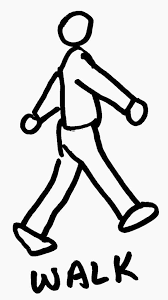
walk基本信息
读法:英 [wɔːk] 美 [wɔk]
释义:
使用频率:★★★★★
星级词汇:★★★★★WwW.wENTIYI.cOM
英英释义
Noun:
"We walked instead of driving"
"She walks with a slight limp"
"The patient cannot walk yet"
"Walk over to the cabinet"
"Paul walked the streets of Damascus"
"She walks 3 miles every day"
"Walk with God"
"Walk the dog twice a day"
"We like to walk every Sunday"
中英词源
walk 步行
来自PIE*wel,转,摇摆,词源同Volvo,voluble。引申词义步行,蛇行,-k,加强语音。
- walk
- walk: [OE] Walk originally meant ‘roll about, toss’ (an 11th-century Anglo-Saxon glossary translated Latin ferventis oceani as ‘walking sea’). This gradually broadened out via ‘move about’ to ‘go on a journey’, but the specific application to ‘travelling on foot’ did not emerge until the 13th century. The verb came from a prehistoric Germanic *walkan, which also produced Dutch walken ‘make felt by beating’ and French gauchir ‘turn aside, detour’ (source of English gauche [18]). It is ultimately related to Sanskrit valgati ‘hops’.
=> gauche - walk (v.)
- "travel on foot," c. 1200, a merger of two verbs, 1. Old English wealcan "to toss, roll, move round" (past tense weolc, past participle wealcen), and 2. wealcian "to roll up, curl," from Proto-Germanic *welk- (cognates: Old Norse valka "to drag about," Danish valke "to full" (cloth), Middle Dutch walken "to knead, press, full" (cloth), Old High German walchan "to knead," German walken "to full"), perhaps ultimately from PIE root *wel- (3) "to turn, roll" (see volvox).
The shift in sense is perhaps from a colloquial use of the Old English word or via the sense of "to full cloth" (by treading on it), though this sense does not appear until after the change in meaning. In 13c. it is used of snakes and the passage of time, and in 15c. of wheeled carts. "Rarely is there so specific a word as NE walk, clearly distinguished from both go and run" [Buck]. Meaning "to go away" is recorded from mid-15c. Transitive meaning "to exercise a dog (or horse)" is from late 15c.; meaning "to escort (someone) in a walk" is from 1620s. Meaning "move (a heavy object) by turning and shoving it in a manner suggesting walking" is by 1890. To walk it off, of an injury, etc., is from 1741. Related: Walked; walking. - walk (n.)
- c. 1200, "a tossing, rolling;" mid-13c., "an act of walking, a going on foot;" late 14c., "a stroll," also "a path, a walkway;" from walk (v.). The meaning "broad path in a garden" is from 1530s. Meaning "particular manner of walking" is from 1650s. Meaning "manner of action, way of living" is from 1580s; hence walk of life (1733). Meaning "range or sphere of activity" is from 1759. Sports sense of "base on balls" is recorded from 1905; to win in a walk (1854) is from horse racing (see walk-over). As a type of sponsored group trek as a fund-raising event, by 1971 (walk-a-thon is from 1963).
词态变化
复数 walks;
第三人称单数 walks;
过去式 walked;
过去分词 walked;
现在分词 walking;
权威造句
- 1. Do not wait for good things to happen to you. You need to walk towards happiness.
- 不要等待好事降临,你要向幸福进发。
来自金山词霸 每日一句
- 2. She went for a brisk walk to work off her frustration.
- 她快步走了一会儿,以排解心中的沮丧。
来自柯林斯例句
- 3. A stiff knee following surgery forced her to walk with a limp.
- 手术后她的膝盖活动不便,走路时被迫跛行。
来自柯林斯例句
- 4. "Can you walk all right?" the nurse asked him.
- “你走路有困难吗?”护士问他。
来自柯林斯例句
- 5. She noticed her own proud walk had become a shuffle.
- 她意识到自己趾高气扬的步伐已变成了拖着脚走路了。
来自柯林斯例句
近反义词
v.
相似短语
单词分析
这些动词均有“行走,徒步”之意。walk最常用词,中性词,指除跑、跳之外所有移步的动作。
stride着重步子大而且节奏有力,流露出匆忙、烦恼、得意等情绪。
stroll多指走走停停,步子缓慢,悠闲自得,漫无目的。
strut指大摇大摆地走,含过分自信或自高自大意味。
pace指踱步,走步。
记忆方法
暂无,等待补充.
版权声明:问题易所有作品(图文、音视频)均来源网络,版权归原创作者所有,与本站立场无关,如不慎侵犯了你的权益,请联系我们告知,我们将做删除处理!