
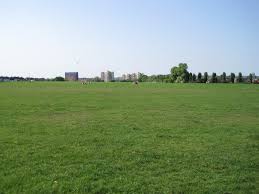
ground基本信息
读法:英 [graʊnd] 美 [ɡraʊnd]
释义:
使用频率:★★★★★
星级词汇:★★★★★
英英释义
Noun:
"the earth shook for several minutes"
"he dropped the logs on the ground"
"the grounds for their declaration"
"he worked on an interim basis"
"they fought to regain the lost ground"
"good agricultural soil"
中英词源
ground 地面
来自古英语grund, 底部,尤指海底。后词义通用化。wWW.wenTIYI.cOM
- ground
- ground: [OE] Ground is part of a widespread family of Germanic words, which include also German, Swedish, and Danish grund and Dutch grond. A common meaning element of all these is ‘bottom’, particularly of the sea (preserved in English ‘run aground’), and it seems that their prehistoric Germanic ancestor *grunduz may originally have denoted something like ‘deep place’.
- ground (v.)
- mid-13c., "to put on the ground, to strike down to the ground;" late 14c., "lay the foundation of," also, figuratively, "to base" (an argument, sermon, etc.), from ground (n.). Meaning "instruct thoroughly in the basics" is from late 14c. Of ships, "to run into the ground," from mid-15c. (intransitive), transitive sense from 1650s. Of arms, from 1711. Electrical sense from 1881. Meaning "deny privileges" is 1940s, originally a punishment meted out to pilots (in which sense it is attested from 1930). In the sense "establish firmly" Old English had grundweallian, grundstaðelian; also gryndan "descend," gegryndan "to found."
- ground (n.)
- Old English grund "bottom; foundation; surface of the earth," also "abyss, Hell," and "bottom of the sea" (a sense preserved in run aground), from Proto-Germanic *grundus, which seems to have meant "deep place" (cognates: Old Frisian, Old Saxon, Danish, Swedish grund, Dutch grond, Old High German grunt, German Grund "ground, soil, bottom;" Old Norse grunn "a shallow place," grund "field, plain," grunnr "bottom"). No known cognates outside Germanic.
Sense of "reason, motive" first attested c. 1200. Meaning "source, origin, cause" is from c. 1400. Electrical sense "connection with the earth" is from 1870 (in telegraphy). Meaning "place where one takes position" is from 1610s; hence stand (one"s) ground (1707). To run to ground in fox-hunting is from 1779. Ground rule (1890) originally was a rule designed for a specific playing field (ground or grounds in this sense attested by 1718); by 1953 it had come to mean "a basic rule." - ground (adj.)
- "reduced to fine particles by grinding," 1765, past participle adjective from grind (v.).
词态变化
复数 grounds;
第三人称单数 grounds;
过去式 grounded;
过去分词 grounded;
现在分词 grounding;
权威造句
- 1. They found a labyrinth of tunnels under the ground.
- 他们发现了一处迷宫似的地道。
来自柯林斯例句
- 2. A violent explosion seemed to jolt the whole ground.
- 剧烈的爆炸好像要把整个地面都掀起来。
来自柯林斯例句
- 3. The armed forces have launched offensives to recapture lost ground.
- 这支武装部队已发动进攻要夺回失去的阵地。
来自柯林斯例句
- 4. On her own ground she knows exactly what she"s doing.
- 她在自己熟悉的领域里对自己的行为有十足的把握。
来自柯林斯例句
- 5. The president said he had no intention of deploying ground troops.
- 总统称并不打算部署地面部队。
来自柯林斯例句
近反义词
n.
相似短语
单词分析
这些名词均含有“基础”之意。base侧重指构成或支撑某一具体物体的基础,也可指军事基地或用作比喻意义。
basis主要用作抽象或引申意义。
foundation用于具体意义时,侧重指坚固结实的建筑物的基础或地基;用作比喻意义时,与basis基本相同。
ground含义与basis和foundation接近。一般指某种决定、论点或关系的基础,也可指某种原因的基础。 这些名词都有“土地,土,泥”之意。
earth多指地表带有水分的泥土,较具体。
clay特指潮湿时发粘,而火烤后变坚硬的泥土。
dirt指地表的干松泥土。
land含义笼统。指与河流、海洋相对的陆地,也指可耕种的土地。
dust特指土壤干燥后,飞扬于空中的细微泥土。
soil特指适宜栽种农作物或生长各种植物的泥土。
mud指湿土,尤指雨后稀泥、污泥。
ground通常指大地的表面,也可指土壤、泥土或场地。
记忆方法
暂无,等待补充.
版权声明:问题易所有作品(图文、音视频)均来源网络,版权归原创作者所有,与本站立场无关,如不慎侵犯了你的权益,请联系我们告知,我们将做删除处理!