
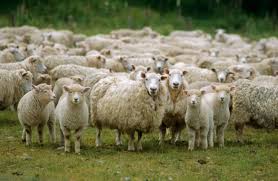
sheep基本信息
读法:英 [ʃiːp] 美 [ʃip]
释义:
使用频率:★★
星级词汇:★★★★
英英释义
Noun:
中英词源
sheep 羊,绵羊
来自古英语 sceap,羊,绵羊,来自 West Germanic*skaepan,羊,绵羊,进一步词源不详。
- sheep
- sheep: [OE] Sheep is a West Germanic word, with relatives in German schaf and Dutch schaap. It is not known where it came from, although it has been speculated that it may be related to German schaffen ‘make, create’ (and hence to English shape), and that its underlying meaning is hence ‘creature’. The derivative sheepish [12] originally meant simply ‘sheeplike’. It had a variety of metaphorical applications in Middle English, including ‘silly’ and ‘fearful’, but the modern ‘shy’ did not emerge until the late 17th century. Shepherd is of course based on sheep.
- sheep (n.)
- ruminant mammal, Old English sceap, scep, from West Germanic *skæpan (cognates: Old Saxon scap, Old Frisian skep, Middle Low German schap, Middle Dutch scaep, Dutch schaap, Old High German scaf, German Schaf), of unknown origin. Not found in Scandinavian (Danish has faar for "sheep") or Gothic (which uses lamb), and with no known cognates outside Germanic. The more usual Indo-European word for the animal is represented in English by ewe.
The plural form was leveled with the singular in Old English, but Old Northumbrian had a plural scipo. Used since Old English as a type of timidity and figuratively of those under the guidance of God. The meaning "stupid, timid person" is attested from 1540s. The image of the wolf in sheep"s clothing was in Old English (from Matt. vii:15); that of separating the sheep from the goats is from Matt. xxv:33. To count sheep in a bid to induce sleep is recorded from 1854 but seems not to have been commonly written about until 1870s. It might simply be a type of a tedious activity, but an account of shepherd life from Australia from 1849 ["Sidney"s Emigrant"s Journal"] describes the night-shepherd ("hut-keeper") taking a count of the sheep regularly at the end of his shift to protect against being answerable for any animals later lost or killed.
Sheep"s eyes "loving looks" is attested from 1520s (compare West Frisian skiepseach, Dutch schaapsoog, German Schafsauge). A sheep-biter was "a dog that worries sheep" (1540s); "a mutton-monger" (1590s); and "a whore-monger" (1610s, i.e. one who "chases mutton"); hence Shakespeare"s sheep-biting "thieving, sneaky."
词态变化
复数 sheep;
权威造句
- 1. She mispronounced ship as sheep.
- 她把ship念成sheep了.
来自《简明英汉词典》
- 2. "ship " doesn"t rhyme with"sheep ".
- Ship 和 sheep 不押韵.
来自《简明英汉词典》
- 3. The first task was to fence the wood to exclude sheep.
- 第一项任务就是把树林围起来不让羊进去。
来自柯林斯例句
- 4. Every summer the shepherds drive the sheep up to pasture.
- 每年夏天牧羊人都将羊群赶到牧场去。
来自柯林斯例句
- 5. Sheep"s milk is produced in much the same way as goat"s milk.
- 绵羊奶和山羊奶的生产过程差不多。
来自柯林斯例句
近反义词
相似短语
单词分析
暂无,等待补充.WwW.wENtIYi.Com
记忆方法
暂无,等待补充.
版权声明:问题易所有作品(图文、音视频)均来源网络,版权归原创作者所有,与本站立场无关,如不慎侵犯了你的权益,请联系我们告知,我们将做删除处理!