
ship基本信息
读法:英 [ʃɪp] 美 [ʃɪp]
释义:
使用频率:★★★★
星级词汇:★★★★★
英英释义
Noun:
中英词源
ship 大船,舰,船运,运输
来自古英语 scip,船,来自 Proto-Germanic*skipa,船,掏空物,来自 PIE*skep,切,分开,来自 PIE*skei,切,分开,词源同 shape,-scape.来自早期掏木为船的原始做法,比较 boat.
- ship
- ship: [OE] Ship comes from a prehistoric Germanic *skipam, which also produced German schiff, Dutch schip, Swedish skepp, and Danish skib. It is not known for certain where this came from, although a link has been suggested with Latvian shkibīt ‘cut, hew’, in which case the underlying meaning of ship could be ‘hollowed-out log’ – a ‘dugout’, in other words.
The Old High German form schif was borrowed into Italian as schifo, and this made its way via French esquif into English as skiff [16]. The Middle Dutch form schip had a derivative schipper ‘captain of a small ship’, which has given English skipper [14]. And equip too comes from a relative of English ship.
=> equip, skiff, skipper - ship (n.)
- Old English scip "ship, boat," from Proto-Germanic *skipam (cognates: Old Norse, Old Saxon, Old Frisian, Gothic skip, Danish skib, Swedish skepp, Middle Dutch scip, Dutch schip, Old High German skif, German Schiff), "Germanic noun of obscure origin" [Watkins]. Others suggest perhaps originally "tree cut out or hollowed out," and derive it from PIE root *skei- "to cut, split."
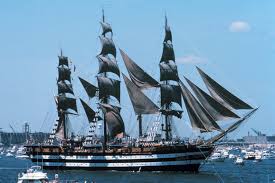
Now a vessel of considerable size, adapted to navigation; the Old English word was used for small craft as well, and definitions changed over time; in 19c., distinct from a boat in having a bowsprit and three masts, each with a lower, top, and topgallant mast. French esquif, Italian schifo are Germanic loan-words.
Phrase ships that pass in the night is from Longfellow"s poem "Elizabeth" in "Tales of a Wayside Inn" (1863). Figurative use of nautical runs a tight ship (i.e., one that does not leak) is attested from 1965. - ship (v.)
- c. 1300, "to send or transport (merchandise, people) by ship; to board a ship; to travel by ship, sail, set sail," also figurative, from ship (n.). Old English scipian is attested only in the senses "take ship, embark; be furnished with a ship." Transferred to other means of conveyance (railroad, etc.) from 1857, originally American English. Related: Shipped; shipping.
词态变化
复数 ships;
第三人称单数 ships;
过去式 shipped;
过去分词 shipped;
现在分词 shipping;
权威造句
- 1. She mispronounced ship as sheep.
- 她把ship念成sheep了.
来自《简明英汉词典》
- 2. "ship " doesn"t rhyme with"sheep ".
- Ship 和 sheep 不押韵.
来自《简明英汉词典》
- 3. Captain Cook safely navigated his ship without accident for 100 voyages.
- 库克船长驾驶的船安全出航100次无事故。
来自柯林斯例句
- 4. Sailors hung about while they waited to ship out.
- 水手们在等待离港的时候四处闲逛。
来自柯林斯例句
- 5. In a naval battle your aim is to sink the enemy"s ship.
- 在海战中目标就是击沉敌船。
来自柯林斯例句
近反义词
n.
相似短语
单词分析
这些名词均含有“船”之意。boat泛指任何大小的船只,尤指靠划桨或风帆行进的无篷小船。
ship含义广,一般指大轮船,如航海船只,内河航运船只。
canoe指长而轻,用桨的小舟、独木船。
steamer指靠蒸汽发动机为动力的船只。
vessel多指运货或运人的大船。
craft船只的集合名词,但可指单独的船只。
记忆方法
暂无,等待补充.
版权声明:问题易所有作品(图文、音视频)均来源网络,版权归原创作者所有,与本站立场无关,如不慎侵犯了你的权益,请联系我们告知,我们将做删除处理!