
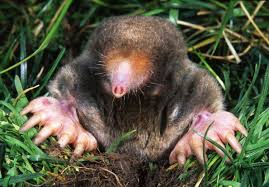
mole基本信息
读法:英 [məʊl] 美 [mol]
释义:
使用频率:★
星级词汇:★★★
英英释义
Noun:
中英词源
mole 鼹鼠,内奸
缩写自molewarp,欧洲鼹鼠。后用于鼹鼠通用名。引申俚语义内奸。
mole 防洪堤
来自拉丁语moles,大块,防洪堤,大工程,大建筑物,来自PIE*mo,努力,劳苦,词源同demolish,molecule,molest.
mole 痣
来自古英语mal,斑点,痣,来自Proto-Germanic*mailan,斑点,记号,来自PIE*mai,涂沫,弄脏,玷污,词源同miasma.
mole 摩尔
分子单位,缩写自molecule.
mole 沙司
来自西班牙语,来自南美土著语molli,沙司,调料,炖料,词源同guacamole.
- mole
- mole: English has four distinct words mole. The oldest is ‘brown spot’ [OE]. It is the descendant of Old English māl, which meant broadly ‘discoloured mark’. This developed in Middle English to ‘spot on the skin’, but the specific sense ‘brown mark’ did not emerge until fairly recently. The word goes back to a prehistoric Germanic *mailam, a derivative of a base meaning ‘spot, mark’ which also produced German malen ‘paint’ and Dutch maalen ‘paint’ (source of English maulstick ‘stick used as a rest by painters’ [17]). Mole the animal [14] was borrowed from Middle Dutch mol.
No one knows for sure where this came from, but its similarity to the now obsolete mouldwarp ‘mole’ [14] (a compound noun whose etymological meaning is ‘earththrower’) suggests that it could represent a truncated version of mouldwarp’s prehistoric Germanic ancestor. The metaphorical application of the word to a ‘traitor working secretly’ has been traced back as far as the 17th century, but its modern currency is due to its use by the British espionage writer John le Carré. Mole ‘harbour wall’ [16] comes via French môle and medieval Greek mólos from Latin mōlēs ‘mass, massive structure’.
The diminutive form of this, coined in modern times, is mōlēcula, from which, via French molécule, English gets molecule [18]. Other relatives are demolish and, possibly, molest [14], which comes ultimately from Latin molestus ‘troublesome’, connected by some scholars with mōlēs. And German mol, a convenient shortening of molekulargewicht ‘molecular weight’, has given English its fourth mole [20], used as the basic unit of measurement for the amount of a substance.
=> maulstick; molecule, molest - mole (n.1)
- spot on skin, Old English mal "spot, mark, blemish," especially on cloth or linen, from Proto-Germanic *mailan "spot, mark" (cognates: Old High German meil, German Mal, Gothic mail "wrinkle"), from PIE root *mai- "to stain, defile" (cognates: Greek miainein "to stain, defile," see miasma). Specifically of dark marks on human skin from late 14c.
- mole (n.2)
- type of small burrowing mammal (Talpa europea), mid-14c., probably from obsolete moldwarp, literally "earth-thrower." Spy sense first recorded 1974 in John le Carré (but suggested from early 20c.), from notion of "burrowing." Metaphoric use for "one who works in darkness" is from c. 1600.
- mole (n.3)
- "breakwater," 1540s, from Middle French môle "breakwater" (16c.), ultimately from Latin moles "mass, massive structure, barrier," from PIE root *mo- "to exert oneself" (cognates: Greek molos "effort," molis "hardly, scarcely;" German mühen "to tire," müde "weary, tired;" Russian majat" "to fatigue, exhaust," maja "hard work").
- mole (n.4)
- unit of molecular quantity, 1902, from German Mol coined 1900 by German chemist Wilhelm Ostwald (1853-1912), short for Molekül (see molecule).
词态变化
复数 moles;
权威造句
- 1. These reactive mole-cules are mopped up and made harmless by Vitamin E.
- 这些活性分子已被维生素E灭活,没有害处了。
来自柯林斯例句
- 2. A mole is a blemish on a person"s skin.
- 黑痣在人的皮肤上是一个疵点.
来自《现代英汉综合大词典》
- 3. The mole bored its way underground.
- 鼹鼠在地下挖掘路.
来自《简明英汉词典》wWw.weNtIYI.cOM
- 4. A mole can undermine the strongest rampart.
- 一只田鼠能毁坏最坚固的堡垒.
来自《简明英汉词典》
- 5. A mole mines its way.
- 鼹鼠挖坑道.
来自《简明英汉词典》
近反义词
相似短语
单词分析
暂无,等待补充.
记忆方法
1. 音译“摩尔”,物质的量的单位。
2. molecule (指小词, 指小词缀:-cul-) <====> mole(摩尔):也许最初好像是认为分子是最小的微粒,据此创造了此单词吧。
3. 一摩尔的微粒是很微小的量 =》 微量,据此表示“微小的污迹,斑点”,进而引申为:痣、胎块。
版权声明:问题易所有作品(图文、音视频)均来源网络,版权归原创作者所有,与本站立场无关,如不慎侵犯了你的权益,请联系我们告知,我们将做删除处理!