
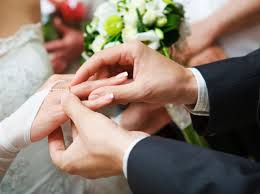
marry基本信息
读法:英 ["mærɪ] 美 ["mæri]
释义:
使用频率:★★★★
星级词汇:★★★★
英英释义
Verb:
"We were wed the following week"
"The couple got spliced on Hawaii"
中英词源
marry 结婚,嫁,娶
来自拉丁语maritare,结婚,婚配,来自martius,求婚者,丈夫,来自PIE*meryo,年青男子,男孩,词源同masculine,male.
- marry
- marry: [13] Latin marīus meant ‘husband’ (it may go back to an Indo-European *mer-, *mor-, which meant something like ‘young person’ – Lithuanian has the related marti ‘bride’ – and in that case would denote etymologically ‘man who has been provided with a young woman as a bride’). From it was derived the verb marītāre ‘marry’, which passed into English via Old French marier. Marriage [13] likewise comes from Old French.
- marry (v.)
- c. 1300, "to give (offspring) in marriage," from Old French marier "to get married; to marry off, give in marriage; to bring together in marriage," from Latin maritare "to wed, marry, give in marriage" (source of Italian maritare, Spanish and Portuguese maridar), from maritus (n.) "married man, husband," of uncertain origin, originally a past participle, perhaps ultimately from "provided with a *mari," a young woman, from PIE root *mari- "young wife, young woman," akin to *meryo- "young man" (source of Sanskrit marya- "young man, suitor").
Meaning "to get married, join (with someone) in matrimony" is early 14c. in English, as is that of "to take in marriage." Said from 1520s of the priest, etc., who performs the rite. Figurative use from early 15c. Related: Married; marrying. Phrase the marrying kind, describing one inclined toward marriage and almost always used with a negative, is attested by 1824, probably short for marrying kind of men, which is from a popular 1756 essay by Chesterfield.
In some Indo-European languages there were distinct "marry" verbs for men and women, though some of these have become generalized. Compare Latin ducere uxorem (of men), literally "to lead a wife;" nubere (of women), perhaps originally "to veil" [Buck]. Also compare Old Norse kvangask (of men) from kvan "wife" (see quean), so, "take a wife;" giptask (of women), from gipta, a specialized use of "to give" (see gift (n.)), so, "to be given." - marry (interj.)
- a common oath in the Middle Ages, mid-14c., now obsolete, a corruption of the name of the Virgin Mary.
词态变化
第三人称单数 marries;
过去式 married;
过去分词 married;
现在分词 marrying;
权威造句
- 1. I will return, find you, love you, marry you and live without shame.
- 我会回去,找到你,爱你,娶你,活的光明正大。《赎罪》
来自金山词霸 每日一句
- 2. In many societies children still marry someone of their parents" choice.
- 在许多社会,子女结婚仍然只能听从父母之命。
来自柯林斯例句
- 3. I think he wanted to marry her, if I am not mistaken.
- 我觉得他曾经想娶她为妻,如果我没有弄错的话。
来自柯林斯例句
- 4. I was under the delusion that he intended to marry me.
- 我误认为他要娶我。
来自柯林斯例句wWw.Wentiyi.cOM
- 5. Between ourselves, I know he wants to marry her.
- 我们私下说说,我知道他想娶她。
来自柯林斯例句
近反义词
相似短语
单词分析
暂无,等待补充.
记忆方法
暂无,等待补充.
版权声明:问题易所有作品(图文、音视频)均来源网络,版权归原创作者所有,与本站立场无关,如不慎侵犯了你的权益,请联系我们告知,我们将做删除处理!