
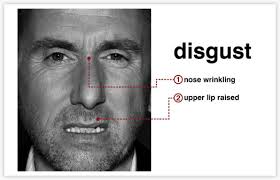
disgust基本信息
读法:英 [dɪs"gʌst] 美 [dɪs"ɡʌst]
释义:
使用频率:★★
星级词汇:★★★Www.WentIyI.CoM
英英释义
Noun:
中英词源
disgust 憎恶
dis-, 不,非,使相反。-gust, 口味,品尝,词源同choose, gustatory.即不合口味,后引申为憎恶。
- disgust
- disgust: [16] Something that disgusts one is literally ‘not to one’s taste’. The word comes from Old French desguster, a compound verb formed from the prefix des- ‘not’ and goust ‘taste’. This in turn came from Latin gustus (ultimate source of English gusto); its modern French descendant is goût. Originally, as its derivation implies, disgust meant simply ‘cause to feel aversion, displease’ (and also, with subject and object reversed, ‘dislike, loathe’: ‘Had he not known that I disgusted it, it had never been spoke or done by him’, Robert South, Sermons 1716); but over the centuries it has hardened into ‘sicken, repel’.
=> gusto - disgust (n.)
- 1590s, from Middle French desgoust "strong dislike, repugnance," literally "distaste" (16c., Modern French dégoût), from desgouster "have a distaste for," from des- "opposite of" (see dis-) + gouster "taste," from Latin gustare "to taste" (see gusto).
- disgust (v.)
- c. 1600, from Middle French desgouster "have a distaste for" (see disgust (n.)). Sense has strengthened over time, and subject and object have been reversed; the older use looks like this: "It is not very palatable, which makes some disgust it" (1660s). The reverse sense of "to excite nausea" is attested from 1640s. Related: Disgusted; disgusting.
词态变化
复数 disgusts;
第三人称单数 disgusts;
过去式 disgusted;
过去分词 disgusted;
现在分词 disgusting;
权威造句
- 1. I turned to Jacky, my nostrils flaring in disgust.
- 我转过身厌恶地看着杰基,鼻翼呼呼地翕动着。
来自柯林斯例句
- 2. She told him that her first reaction was disgust.
- 她告诉他自己的第一反应是厌恶。
来自柯林斯例句
- 3. He rolled his eyes heavenward in disgust.
- 他厌恶地翻着白眼。
来自柯林斯例句
- 4. I threw the book aside in disgust.
- 我厌恶地把书扔到一边。
来自柯林斯例句
- 5. Hean looked down at Bauer in undisguised disgust.
- 希恩低头看了看鲍尔,毫不掩饰自己的厌恶。
来自柯林斯例句
近反义词
n.
相似短语
单词分析
这些动词均含有“不喜欢”之意。dislike普通用词,指任何程度的憎恶,但永远指正面的憎恶和反对。
hate指因对某人或某事强烈不满或反感,或因利害关系等而产生憎恨。
disgust指对令人不快、生厌或坏的东西或行为怀有强烈的憎恶。 这些动词均有“恨,厌恶”之意。
hate最普通常用词,指因利害冲突或出于正义感或其它因素而对人或物或某种行为表示厌恶,憎恨或极不满。
disgust多指对丑恶的行为或对令人不快的事或坏的东西有强烈的憎恶之感。
dislike语气较弱,指一般的厌烦或不喜欢,有时可能是天生的反感。
记忆方法
1、dis- "opposite of" + gust-.
2、literally "distaste".
版权声明:问题易所有作品(图文、音视频)均来源网络,版权归原创作者所有,与本站立场无关,如不慎侵犯了你的权益,请联系我们告知,我们将做删除处理!