
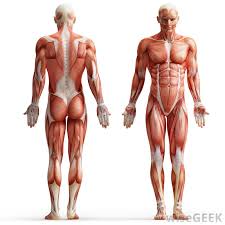
muscle基本信息
读法:英 ["mʌs(ə)l] 美 ["mʌsl]
释义:
使用频率:★★★
星级词汇:★★★★
英英释义
Noun:
中英词源
muscle 肌肉
来自拉丁语musculus,小老鼠,肌肉,来自mus,老鼠,词源同mouse,-cul,小词后缀。因古人认为鼓起的肌肉形如跳跃的小老鼠而得名。
- muscle
- muscle: [16] Ultimately, muscle and mussel [OE] are the same word, and both owe their origin to a supposed resemblance to a mouse. They go back to Latin mūsculus, literally ‘little mouse’, a diminutive form of mūs ‘mouse’, which was applied to the shellfish because of a similarity in shape and colour, and to ‘muscle’ because the shape and movement of certain muscles beneath the skin, such as the biceps, reminded people of a mouse.
Latin mūsculus ‘mussel’ was borrowed into Old English as muscle or muxle; the -ssspelling began to emerge in the 15th century, inspired by Middle Low German mussel (which came from *muscula, a Vulgar Latin feminization of Latin mūsculus and source of French moule ‘mussel’) and reinforced in the 16th century by the introduction via Old French of muscle for ‘muscle’.
The notion of resemblance to a mouse also lies behind English musk.
=> mouse, mussel - muscle (n.)
- late 14c., from Middle French muscle "muscle, sinew" (14c.) and directly from Latin musculus "a muscle," literally "little mouse," diminutive of mus "mouse" (see mouse (n.)).
So called because the shape and movement of some muscles (notably biceps) were thought to resemble mice. The analogy was made in Greek, too, where mys is both "mouse" and "muscle," and its comb. form gives the medical prefix myo-. Compare also Old Church Slavonic mysi "mouse," mysica "arm;" German Maus "mouse; muscle," Arabic "adalah "muscle," "adal "field mouse." In Middle English, lacerte, from the Latin word for "lizard," also was used as a word for a muscle.Musclez & lacertez bene one selfe þing, Bot þe muscle is said to þe fourme of mouse & lacert to þe fourme of a lizard. [Guy de Chauliac, "Grande Chirurgie," c. 1425]
Hence muscular and mousy are relatives, and a Middle English word for "muscular" was lacertous, "lizardy." Figurative sense of "force, violence, threat of violence" is 1930, American English. Muscle car "hot rod" is from 1969. - muscle (v.)
- 1913, "to accomplish by strength," from muscle (n.). Related: Muscled; muscling. To muscle in is 1929 in underworld slang.
词态变化
复数 muscles;
形容词 muscled;
WWw.WENTIyI.CoM
权威造句
- 1. Eisenhower used his muscle to persuade Congress to change the law.
- 艾森豪威尔用他的影响力说服国会修改了该项法律。
来自柯林斯例句
- 2. Dave pulled a back muscle and could barely kick the ball.
- 戴夫背部拉伤,几乎没法踢球。
来自柯林斯例句
- 3. This can lead to bodily weakness and muscle wastage.
- 这样可能会导致身体虚弱和肌肉萎缩。
来自柯林斯例句
- 4. They call rowing the perfect sport. It exercises every major muscle group.
- 他们称划船是最佳运动,它可以锻炼每一处主要肌肉群。
来自柯林斯例句
- 5. The body is made up primarily of bone, muscle, and fat.
- 人体主要是由骨骼、肌肉和脂肪构成。
来自柯林斯例句
近反义词
相似短语
单词分析
暂无,等待补充.
记忆方法
1. from Latin musculus "a muscle," literally "little mouse," diminutive of mus "mouse" (see mouse).
2. So called because the shape and movement of some muscles (notably biceps) were thought to resemble mice.
版权声明:问题易所有作品(图文、音视频)均来源网络,版权归原创作者所有,与本站立场无关,如不慎侵犯了你的权益,请联系我们告知,我们将做删除处理!