
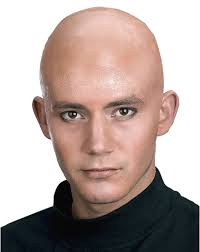
bald基本信息
读法:英 [bɔːld] 美 [bɔld]
释义:
使用频率:★★
星级词汇:★★★
英英释义
Adjective:
"a bald-headed gentleman"
"bare hills"
中英词源
bald 秃头
来自PIE *bhel(1), 发光,词源同blank, blanch.
- bald
- bald: [14] In Middle English times, bald was ballede, which suggests that it may have been a compound formed in Old English with the suffix -ede ‘characterized by, having’. It has been conjectured that the first element in the compound was Old English *ball-, meaning ‘white patch’ or ‘blaze’ on an animal’s head; this may be supported by isolated examples of the use of the adjective to mean (of a horse) ‘whitefaced’ from the 16th to the 18th centuries, and by the obsolete dialectal ball meaning both ‘white patch on the head’ and ‘white-faced horse’.
This would have produced the Old English adjective *bællede or *beallede, which, from ‘having a white blaze’, progressed naturally in meaning to ‘hairless’. The compounds piebald [16] and skewbald [17] are both based on bald: piebald means ‘having black and white patches like a magpie’, while skewbald may be based on Middle English skew ‘(cloudy) skies’ or on Old French escu ‘shield’.
=> piebald, skewbald - bald (adj.)
- c. 1300, ballede, probably, with Middle English -ede adjectival suffix + Celtic bal "white patch, blaze" especially on the head of a horse or other animal (from PIE root *bhel- (1) "to shine, flash, gleam;" see bleach (v.)). Compare, from the same root, Sanskrit bhalam "brightness, forehead," Greek phalos "white," Latin fulcia "coot" (so called for the white patch on its head), Albanian bale "forehead." But connection with ball (n.1), on notion of "smooth, round" also has been suggested. Bald eagle first attested 1680s; so called for its white head.
词态变化
比较级 balder;
最高级 baldest;
名词 baldness;
权威造句
- 1. He was short and bald and had a moustache.
- 他个头不高,秃顶,留着八字胡。
来自柯林斯例句
- 2. The announcement came in a bald statement from the official news agency.
- 官方通讯社发表了直截了当的声明。
来自柯林斯例句
- 3. The bald truth is he"s just not happy.
- 事实明摆着,他就是不开心。
来自柯林斯例句wwW.weNTiyi.coM
- 4. His toupee dropped off, revealing his bald head.
- 他的假发掉了,露出了光头。
来自柯林斯例句
- 5. I"m going bald.
- 我开始秃头了。
来自柯林斯例句
近反义词
相似短语
单词分析
这些形容词都含“裸露的”之意。bare指缺少必要的遮盖物。用于人时,多指身体的部分裸露。
naked指全身一丝不挂,暴露无遗。
bald指头上无发,山坡无树无草,树顶无叶。
barren着重缺少肥力或生活能力,无草无木,荒瘠不毛。
记忆方法
暂无,等待补充.
版权声明:问题易所有作品(图文、音视频)均来源网络,版权归原创作者所有,与本站立场无关,如不慎侵犯了你的权益,请联系我们告知,我们将做删除处理!