
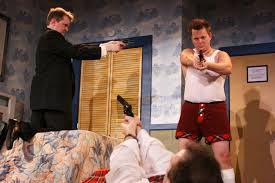
farce基本信息
读法:英 [fɑːs] 美 [fɑrs]
释义:
使用频率:★
星级词汇:★★
英英释义
Noun:
中英词源
farce 闹剧
来自拉丁语farcire, 塞进,填塞,词源同force-meat. 可能来自PIE*ger, 塞,充满,词源同cram, crowd. 后用于指大杂烩,闹剧。
- farce
- farce: [14] Farce originally meant ‘stuff’ (widening gastronomic knowledge in the late 20th century has made us more familiar with its French cousin farcir ‘stuff’, and the force- of forcemeat [17] is the same word). It came via Old French farsir from Latin farcīre ‘stuff’. The Latin verb was used in the Middle Ages for the notion of inserting additional passages into the text of the Mass, and hence to padding out any text. A particular application was the insertion of impromptu, usually comical interludes into religious plays, which had led by the 16th century to something approaching the modern meaning of farce.
=> forcemeat - farce (n.)
- late 14c., "force-meat, stuffing;" 1520s, in the dramatic sense "ludicrous satire; low comedy," from Middle French farce "comic interlude in a mystery play" (16c.), literally "stuffing," from Old French farcir "to stuff," (13c.), from Latin farcire "to stuff, cram," which is of uncertain origin, perhaps from PIE *bhrekw- "to cram together," and thus related to frequens "crowded."
... for a farce is that in poetry which grotesque is in a picture. The persons and action of a farce are all unnatural, and the manners false, that is, inconsisting with the characters of mankind. [Dryden, "A Parallel of Poetry and Painting"]
According to OED and other sources, the pseudo-Latin farsia was applied 13c. in France and England to praise phrases inserted into liturgical formulae (for example between kyrie and eleison) at the principal festivals, then in Old French farce was extended to the impromptu buffoonery among actors that was a feature of religious stage plays. Generalized sense of "a ridiculous sham" is from 1690s in English.
词态变化
复数 farces;
权威造句
- 1. The plot often borders on farce.
- 情节常常近乎荒诞。
来自柯林斯例句
- 2. The elections have been reduced to a farce.
- 竞选演变为一场闹剧。
来自柯林斯例句
- 3. The story has elements of tragedy and farce.
- 这个故事兼有悲剧与闹剧的元素。
来自柯林斯例句
- 4. They played a shameful [ despicable ] role in this farce.
- 他们在这场闹剧中扮演了可耻 [ 鄙 ] 的角色.
来自《现代汉英综合大词典》
- 5. Our school dramas tend towards comedy and farce.
- 我们学校编排的戏剧倾向于喜剧和滑稽剧.
来自《简明英汉词典》
近反义词
相似短语
单词分析
暂无,等待补充.
记忆方法
farce 滑稽戏 “卓别林发誓要演好滑稽戏”
1. forcemeat, infarct => farce "force-meat, stuffing".
2. An earlier sense of ‘forcemeat stuffing’ became used metaphorically for comic interludes ‘stuffed’ into the texts of religious plays, which led to the current usage.
3. 谐音“滑死”----滑稽死了(花发不分、飞灰不分、飞机说成灰机,于是有了此谐音)。
版权声明:问题易所有作品(图文、音视频)均来源网络,版权归原创作者所有,与本站立场无关,如不慎侵犯了你的权益,请联系我们告知,我们将做删除处理!