
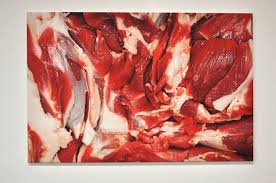
flesh基本信息
读法:英 [fleʃ] 美 [flɛʃ]
释义:
使用频率:★★
星级词汇:★★★★
英英释义
Noun:
"he has a strong physique"
"the spirit is willing but the flesh is weak"
中英词源
flesh 肉体
可能来自PIE*pleik, 撕,剥,词源同flay. 即剥皮,肉体。比较carnal, corium.
- flesh
- flesh: [OE] The etymological notion underlying flesh, and its near relative flitch ‘side of bacon’ [OE], is of ‘slitting open and cutting up an animal’s carcase for food’. It, together with its continental cousins, German fleisch and Dutch vleesch ‘flesh’ and Swedish fläsk ‘bacon’, comes ultimately from Indo-European *pel- ‘split’. Consequently, the earliest recorded sense of the Old English word flǣsc is ‘meat’; the broader ‘soft animal tissue’, not necessarily considered as food, seems to have developed in the late Old English period.
=> flitch - flesh (n.)
- Old English flæsc "flesh, meat, muscular parts of animal bodies; body (as opposed to soul)," also "living creatures," also "near kindred" (a sense now obsolete except in phrase flesh and blood), common West and North Germanic (compare Old Frisian flesk, Middle Low German vlees, German Fleisch "flesh," Old Norse flesk "pork, bacon"), which is of uncertain origin; according to Watkins, perhaps from Proto-Germanic *flaiskjan "piece of meat torn off," from PIE *pleik- "to tear."
Of fruits from 1570s. Figurative use for "carnal nature, animal or physical nature of man" (Old English) is from the Bible, especially Paul"s use of Greek sarx, and this led to sense of "sensual appetites" (c. 1200).
Flesh-wound is from 1670s; flesh-color, the hue of "Caucasian" skin, is first recorded 1610s, described as a tint composed of "a light pink with a little yellow" [O"Neill, "Dyeing," 1862]. In the flesh "in a bodily form" (1650s) originally was of Jesus (Wyclif has up the flesh, Tindale after the flesh). An Old English poetry-word for "body" was flæsc-hama, literally "flesh-home." A religious tract from 1548 has fleshling "a sensual person." Flesh-company (1520s) was an old term for "sexual intercourse." - flesh (v.)
- 1520s, "to render (a hunting animal) eager for prey by rewarding it with flesh from a kill," with figurative extensions, from flesh (n.). Meaning "to clothe or embody with flesh," with figurative extensions, is from 1660s. Related: Fleshed; fleshing.
词态变化
权威造句
- 1. I was heading on a secret mission that made my flesh crawl.
- 我正要执行一项让我心惊肉跳的秘密任务。
来自柯林斯例句
- 2. I grab George"sarm and dig my nails into his flesh.
- 我抓住乔治的胳膊,指甲抠进了他的肉里。
来自柯林斯例句
- 3. There may even be some wire or nylon biting into the flesh.
- 甚至可能有一些金属丝或者尼龙线勒到肉里。
来自柯林斯例句
- 4. Remove the seeds and stones and cube the flesh.
- 把籽和果核弄掉,将果肉切成小方块。
来自柯林斯例句
- 5. The flesh of his cheeks seemed to have yellowed.
- 他似乎有些面色发黄。
来自柯林斯例句wWW.wENTIYi.com
近反义词
相似短语
单词分析
这两个名词均含“肉”之意。meat是肉类的总称,指食用的肉,但不包括鱼类的肉。
flesh主要指人体或动物身上的肌肉组织,是从生理角度着眼的。也指动物的肉食。
记忆方法
暂无,等待补充.
版权声明:问题易所有作品(图文、音视频)均来源网络,版权归原创作者所有,与本站立场无关,如不慎侵犯了你的权益,请联系我们告知,我们将做删除处理!