
ass基本信息
读法:英 [æs] 美 [æs]
释义:
使用频率:★★
星级词汇:★
英英释义
Noun:
"are you going to sit on your fanny and do nothing?"
中英词源
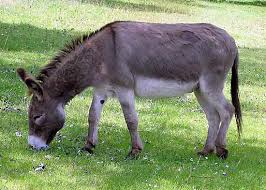
ass 驴,屁股
来自拉丁语asinus.
- ass
- ass: [OE] Ass comes ultimately from Latin asinus ‘donkey’ (whence English asinine [16]), and English probably acquired it via a Celtic route, from a prehistoric Old Celtic *as(s)in (source of Welsh asyn). As borrowed directly into the Germanic languages, by contrast, the n of Latin asinus changed to l; from this branch of the word’s travels Old English had esol, long defunct, and Dutch has ezel, which English has appropriated as easel. Further back in time the word’s antecedents are unclear, but some would trace it to Sumerian ansu, which could also be the source of Greek ónos (whence English onager ‘wild ass’ [14]) and Armenian eš.
=> easel, onager - ass (n.1)
- beast of burden, Old English assa (Old Northumbrian assal, assald) "he-ass," probably from Old Celtic *as(s)in "donkey," which (with German esel, Gothic asilus, Lithuanian asilas, Old Church Slavonic osl) ultimately is from Latin asinus, which is probably of Middle Eastern origin (compare Sumerian ansu).
For al schal deie and al schal passe, Als wel a Leoun as an asse. [John Gower, "Confessio Amantis," 1393]
Since ancient Greek times, in fables and parables, the animal typified clumsiness and stupidity (hence asshead, late 15c., etc.). To make an ass of oneself is from 1580s. Asses" Bridge (c. 1780), from Latin Pons Asinorum, is fifth proposition of first book of Euclid"s "Elements." In Middle English, someone uncomprehending or unappreciative would be lik an asse that listeth on a harpe. In 15c., an ass man was a donkey driver. - ass (n.2)
- slang for "backside," first attested 1860 in nautical slang, in popular use from 1930; chiefly U.S.; from dialectal variant pronunciation of arse (q.v.). The loss of -r- before -s- attested in several other words (such as burst/bust, curse/cuss, horse/hoss, barse/bass, garsh/gash). Indirect evidence of the change from arse to ass can be traced to 1785 (in euphemistic avoidance of ass "donkey" by polite speakers) and perhaps to Shakespeare, if Nick Bottom transformed into a donkey in "A Midsummer Night"s Dream" (1594) is the word-play some think it is. Meaning "woman regarded as a sexual object" is from 1942. To have (one"s) head up (one"s) ass "not know what one is doing" is attested by 1969. Colloquial (one"s) ass "one"s self, one"s person" attested by 1958.
词态变化
复数 asses;
权威造句
- 1. Just play it safe, cover your ass, keep your head down.
- 要谨慎行事,保护好自己并保持低调。
来自柯林斯例句
- 2. They"ve really been kicking ass lately — busting places up, harassing everybody.
- 他们最近真是让人气不打一处来,闹得天翻地覆,搅得每个人都不得安宁。
来自柯林斯例句WwW.wEntiYi.COm
- 3. He was generally disliked and regarded as a pompous ass.
- 他常不招人待见,而且被看作是个自负的大傻帽儿。
来自柯林斯例句
- 4. Don"t be such an ass!
- 别那么傻头傻脑的!
来自《权威词典》
- 5. The donkey is a domesticated form of the African wild ass.
- 驴是非洲野驴的一种已驯化的品种.
来自《简明英汉词典》
近反义词
相似短语
单词分析
这两个名词都表示“驴”之意。donkey是普通常用词。
ass指驴时显得较古。
记忆方法
暂无,等待补充.
版权声明:问题易所有作品(图文、音视频)均来源网络,版权归原创作者所有,与本站立场无关,如不慎侵犯了你的权益,请联系我们告知,我们将做删除处理!