
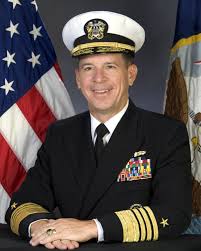
admiral基本信息
读法:英 ["ædm(ə)r(ə)l] 美 ["ædmərəl]
释义:
使用频率:★★
星级词汇:★
英英释义
Noun:
中英词源
admiral 舰队司令
来自阿拉伯语emir, 酋长。后词源俗化为admire的名词形式。
- admiral
- admiral: [13] Admirals originally had nothing specifically to do with the sea. The word comes ultimately from Arabic ’amīr ‘commander’ (from which English later also acquired emir [17]). This entered into various titles followed by the particle -al- ‘of’ (’amīr-al-bahr ‘commander of the sea’, ’amīr-al-mūminīn ‘commander of the faithful’), and when it was borrowed into European languages, ’amīr-al- became misconstrued as an independent, free-standing word.
Moreover, the Romans, when they adopted it, smuggled in their own Latin prefix ad-, producing admiral. When this reached English (via Old French) it still meant simply ‘commander’, and it was not until the time of Edward III that a strong naval link began to emerge. The Arabic title ’amīr-al-bahr had had considerable linguistic influence in the wake of Arabic conquests around the Mediterranean seaboard (Spanish almirante de la mar, for instance), and specific application of the term to a naval commander spread via Spain, Italy, and France to England.
Thus in the 15th century England had its Admiral of the Sea or Admiral of the Navy, who was in charge of the national fleet. By 1500 the maritime connection was firmly established, and admiral came to be used on its own for ‘supreme naval commander’.
=> emir - admiral (n.)
- c. 1200, "Saracen commander or chieftain," from Old French amirail (12c.) "Saracen military commander; any military commander," ultimately from medieval Arabic amir "military commander," probably via Medieval Latin use of the word for "Muslim military leader." Meaning "highest-ranking naval officer" in English is from early 15c. The extension of the word"s meaning from "commander on land" to "commander at sea" likely began in 12c. Sicily with Medieval Latin amiratus and then spread to the continent, but the word also continued to mean "Muslim military commander" in Europe in the Middle Ages.
The intrusive -d- probably is from influence of Latin ad-mirabilis (see admire). Italian form almiraglio, Spanish almirante are from confusion with Arabic words in al-. As a type of butterfly, from 1720, possibly a corruption of admirable.
词态变化
复数 admirals;
www.wENtIyI.cOm
权威造句
- 1. He was hand-picked for this job by the Admiral.
- 他是由海军上将精心挑选出来担任这项工作的。
来自柯林斯例句
- 2. He had never met a real live admiral.
- 他从来没遇到过一位真正的海军上将。
来自柯林斯例句
- 3. He abused the Admiral in the grossest terms.
- 他用不堪入耳的话辱骂那位海军上将。
来自柯林斯例句
- 4. The admiral visited the ships under his command.
- 舰队司令视察了他所统率的军舰。
来自《权威词典》
- 5. Fleet Admiral William Hunter
- 海军五星上将威廉∙亨特
来自《权威词典》
近反义词
相似短语
单词分析
暂无,等待补充.
记忆方法
暂无,等待补充.
版权声明:问题易所有作品(图文、音视频)均来源网络,版权归原创作者所有,与本站立场无关,如不慎侵犯了你的权益,请联系我们告知,我们将做删除处理!