
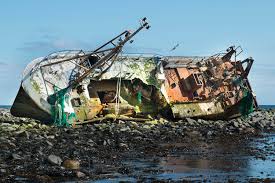
wreck基本信息
读法:英 [rek] 美 [rɛk]
释义:
使用频率:★★
星级词汇:★★★★
英英释义
Noun:
"thanks to that quack I am a human wreck"
中英词源
wreck 沉船,损坏
来自PIE*wreg,推,驱动,践踏,来自PIE*wer的扩大形式,弯,转,扭曲,词源同urgent,wreak。引申义扭曲的物体,主要用于指船的残骸,失事的船只等。
- wreck
- wreck: [13] Wreck goes back ultimately to the Indo-European base *wreg-, a variant of which may be responsible for English urge. Its Germanic descendant *wrek- formed the basis of a verb *wrekan ‘drive’. The native English descendant of this is wreak [OE], which originally meant ‘drive out’, and developed its modern meaning via ‘give vent to anger or other violent emotions’. Wreck itself was acquired via Old Norse *wrek and Anglo-Norman wrec, and etymologically it denotes a ship that has been ‘driven’ on to the shore.
A variant of the same base, *wrak-, lies behind English wretch [OE] (etymologically someone ‘driven’ out, an ‘exile’) and also possibly French garçon ‘boy’.
=> urge, wreak, wretch - wreck (n.)
- early 13c., "goods cast ashore after a shipwreck, flotsam," from Anglo-French wrec, from a Scandinavian source akin to Old Norse *wrek "wreck, flotsam" (cognates: Norwegian, Icelandic rek), related to reka "to drive, push," from Proto-Germanic *wrekan (see wreak (v.)). The meaning "a shipwreck" is first recorded mid-15c.; that of "a wrecked ship" is by c. 1500. General sense of "remains of anything that has been ruined" is recorded from 1713; applied by 1795 to dissipated persons. Compare wrack (v.).
- wreck (v.)
- "to destroy, ruin," c. 1500, from wreck (n.). Earlier (12c.) it meant "drive out or away, remove;" also "take vengeance." Intransitive sense from 1670s. Related: Wrecked; wrecking.
词态变化
复数 wrecks;
第三人称单数 wrecks;
过去式 wrecked;
过去分词 wrecked;
现在分词 wrecking;
权威造句
- 1. The Navy is to carry out an examination of the wreck tomorrow.
- 海军明天将对失事船只进行细查。
来自柯林斯例句
- 2. What would he tell his parents if he had a wreck?
- 如果他出了事故,他怎么向他的父母交代?
来自柯林斯例句
- 3. The pilot struggled out of the wreck almost uninjured.
- 飞行员艰难地从失事的飞机中爬出来,几乎没有受伤。
来自柯林斯例句
- 4. The precise location of the wreck was discovered in 1988.
- 残骸的确切位置是在1988年发现的。
来自柯林斯例句
- 5. This sighting occurred during my dive to a sunken wreck off Sardinia.
- 这是我在撒丁岛附近的沉船残骸处潜水时所见的景象。
来自柯林斯例句
wwW.WEntiyi.cOm
近反义词
相似短语
单词分析
这些动词均有“破坏,损坏”之意。break普通用词,指某物因被打破或撕破而受到破坏,可指有形或无形的破坏。
destroy多指彻底地、毁灭性地破坏,含导致无用,不能或很难再修复的意味。
ruin多指因外部原因而受到严重破坏或毁灭,侧重破坏的彻底性,也可用于引申意义。
wreck侧重指船只、车辆、房屋等受到严重破坏或完全毁坏,也可指计划、健康受到损害。
damage多指对无生命物体的损害,造成降低价值、破坏功能等后果。
spoil强调不仅会削弱力量、精力或价值,而且会导致不可避免的毁灭。
记忆方法
暂无,等待补充.
版权声明:问题易所有作品(图文、音视频)均来源网络,版权归原创作者所有,与本站立场无关,如不慎侵犯了你的权益,请联系我们告知,我们将做删除处理!