
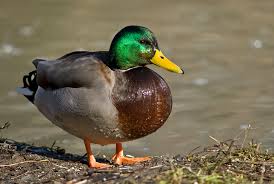
duck基本信息
读法:英 [dʌk] 美 [dʌk]
释义:
使用频率:★★
星级词汇:★★★★
英英释义
Noun:
"she skirted the problem"
"They tend to evade their responsibilities"
"he evaded the questions skillfully"
中英词源
duck 按入水中,躲避,鸭子
可能来自PIE*dhewb, 深的,浸,潜,词源同deep, dip. 因鸭子喜欢潜水而命名。
- duck
- duck: [OE] A duck is a bird that ‘ducks’ – as simple as that. It gets its name from its habit of diving down under the surface of the water. There is no actual record of an English verb duck until the 14th century, but it is generally assumed that an Old English verb *dūcan did exist, which would have formed the basis of the noun duck. It came from a prehistoric West Germanic verb *dukjan, which also produced German tauchen ‘dive’.
English is the only language which uses this word for the bird, although Swedish has the term dykand, literally ‘dive-duck’, which refers to the ‘diver’, a sort of large waterbird. Nor is it the original English word: the Anglo-Saxons mainly called the duck ened, a term which survived until the 15th century. This represents the main Indo-European name for the duck, which comes from an original *anə ti- and is found in Greek nessa, Latin anas, German ente, Dutch eend, Swedish and, and Russian utka. - duck (n.1)
- waterfowl, Old English duce (found only in genitive ducan) "a duck," literally "a ducker," presumed to be from Old English *ducan "to duck, dive" (see duck (v.)). Replaced Old English ened as the name for the bird, this being from PIE *aneti-, the root of the "duck" noun in most Indo-European languages.
In the domestic state the females greatly exceed in number, hence duck serves at once as the name of the female and of the race, drake being a specific term of sex. [OED]
As a term of endearment, attested from 1580s. duck-walk is 1930s; duck soup "anything easily done" is by 1899. Duck"s ass haircut is from 1951. Ducks-and-drakes, skipping flat stones on water, is from 1580s; the figurative sense of "throwing something away recklessly" is c. 1600. - duck (n.2)
- "strong, untwilled linen (later cotton) fabric," used for sails and sailors" clothing, 1630s, from Dutch doeck "linen cloth" (Middle Dutch doec), related to German Tuch "piece of cloth," Danish dug, Old Frisian dok, Old High German tuoh, all of unknown origin.
- duck (v.)
- "to plunge into" (transitive), c. 1300; to suddenly go under water (intransitive), mid-14c., from presumed Old English *ducan "to duck," found only in derivative duce (n.) "duck" (but there are cognate words in other Germanic languages, such as Old High German tuhhan "to dip," German tauchen "to dive," Old Frisian duka, Middle Dutch duken "to dip, dive," Dutch duiken), from Proto-Germanic *dukjan.
Sense of "bend, stoop quickly" is first recorded in English 1520s. Related: Ducked; ducking. The noun is attested from 1550s in the sense of "quick stoop;" meaning "a plunge, dip" is from 1843.
词态变化
复数 ducks;
第三人称单数 ducks;
过去式 ducked;
过去分词 ducked;
现在分词 ducking;
权威造句
- 1. Drizzle the remaining dressing over the duck and salad.
- 将剩下的调料淋在鸭肉和色拉上。
来自柯林斯例句wWw.WeNtiYi.COm
- 2. All the criticism is water off a duck"s back to me.
- 批评对我来说左耳进右耳出,毫无影响。
来自柯林斯例句
- 3. She took to mothering like a duck to water.
- 她很快就对母亲这一角色驾轻就熟了。
来自柯林斯例句
- 4. She chose a bench beside the duck pond and sat down.
- 她在鸭塘边找了条长椅坐下。
来自柯林斯例句
- 5. You can"t duck out once you"ve taken on a responsibility.
- 一旦承担起责任你就不能逃避。
来自柯林斯例句
近反义词
相似短语
单词分析
这些动词均有“沉浸,浸入”之意。immerse侧重全部被液体所覆盖,也可用于比喻意义。
dip指部分地、暂时地或轻微地放进液体,多暗示一种谨慎或试探性的动作。
duck指把头伸进水中,或指游泳时开玩笑地把一个人的头按入水中。
plunge暗示迅速而有力的动作,但浸入不一定很深。
submerge指长时间的完全浸入、潜入,强调浸入液体深层。
记忆方法
暂无,等待补充.
版权声明:问题易所有作品(图文、音视频)均来源网络,版权归原创作者所有,与本站立场无关,如不慎侵犯了你的权益,请联系我们告知,我们将做删除处理!